DOW-UAP-D146

AAWSAP DIRD, Aneutronic Fusion Propulsion II, November 2010, page 16

One page of a U.S. government record released under PURSUE, shown on its own with its text. The record page has the whole document, its catalog details and the scan.

Page
16 of 36
Agency
Department of War
Released
Release 06, September 18, 2026

Text of page 16

UNCLASSIFIED//EAR OFFICIAL USE ONLT Chapter 3: Fusion Propulsion FUSION REACTORS FOR PROPULSION Controlled nuclear fusion reactors have been seriously studied since the late 1960s after tokomaks demonstrated a very promising improvement in temperature and confinement time that had potential to become power-producing reactors. After 15 years, such studies predicted that the size and complexity of a DT (deuterium tritium) - fueled Tokomak would be prohibitively too large to be considered for aerospace applications. However, in the early 1990s when it became clear from large tokomak experimental results that controlled fusion for terrestrial power generation would require an indeterminate time to develop, a surge of interest in fusion-powered propulsion grew. All such studies abandoned the use of DT fusion fuels because of the need for heavy shielding for the 14-MeV neutrons and the requirement for launch safety and the additional complexity of breeding tritium. Only (D,3He) (deuterium helium-3) and (p,11B) (hydrogen boron) fuels have been considered because of the higher specific powers achievable for air and space flight. Field-Reversed Configuration Reactors (U) The seminal study on fusion propulsion that developed specific design parameters was performed in 1993,10 It reviewed previous studies and used a generic cylindrical fuel (shown in Figure 8). The estimated gross mass of the 968-MW reactor was 112 Mg with a corresponding mass of 999 Mg for a DT-fueled system, (1Mg=1 metric ton). Optimization of this conceptual design using the FRC plasma confinement using colliding beams has led to a much more compact configuration of 33 Mg producing 100 MW (shown in Figure 9).11 This reactor's plasma confinement chamber has a length of 7 meters and diameter of 0.84 meters. Half of the plasma fusion products and unfused fuel is circulated through the magnetic separatrix to a direct converter while the other half is diverted and expelled to provide propulsive thrust. 12 Specific Power (kW/kg) 10 - 4- 2 D-3He Long-Term D-3He Mid-Term - D-T Mid-Term -- 25 50 75 100 125 150 175 200 Plasma Temperature (keV) Figure 8. Specific Power as a Function of Plasma Temperature of Fusion Rocket 1 UNCLASSIFIED//FOR OFFICIAL USE ONLY

Machine-read (OCR) from the scan by this archive; it can contain errors. The scan is the record.
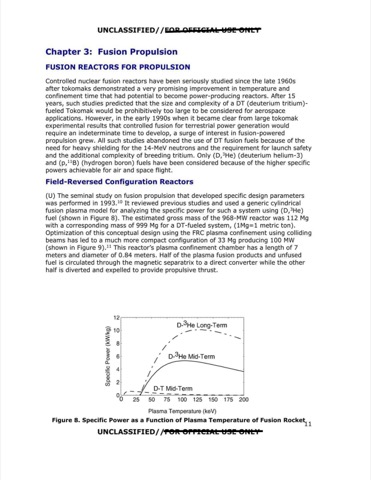
Image from page 16 of DOW-UAP-D146, as released by war.gov
Image from page 16 of the PDF. Open the scan to see the whole page.

Cite this page

U.S. Department of War. "AAWSAP DIRD, Aneutronic Fusion Propulsion II, November 2010" (DOW-UAP-D146). PURSUE Release 06, U.S. Department of War, September 18, 2026. https://www.war.gov/medialink/ufo/sept-18/release-06/assets/DOW-UAP-D146_AAWSAP-DIRD-Aneutronic-Fusion-Propulsion-II-November-1-2010.pdf. Declassified UAP, page 16, https://declassifieduap.org/r/dow-uap-d146-aawsap-dird-aneutronic-fusion-propulsion-ii-november-2010/p/16. Accessed November 28, 2026.

This address shows page 16 on its own; /r/dow-uap-d146-aawsap-dird-aneutronic-fusion-propulsion-ii-november-2010?page=16 opens the same page in the full reader. Both stay. How to cite.