Text of page 10
UNCLASSIFIED//FOR OFFICIAL USE ONLY
In order to facilitate efficient fusion, it is also necessary to constrain the motions of the
charged particles (i.e., confine the plasma) in an attempt to maximize the likelihood of
ion collisions. Therefore, the net energy produced by the fusion process is more
realistically the released energy minus the energy consumed for plasma heating and
confinement. The fusion energy gain factor, usually expressed with the symbol Q, is the
ratio of fusion power produced in a nuclear fusion reactor to the power required to
maintain the plasma temperature; for the Lawson Criterion, breakeven Q = 1. However,
to provide sufficient energy to convert that power to a useful level, a minimum Q > 5 is
needed, and for a power plant to generate electricity the Q should be > 30.
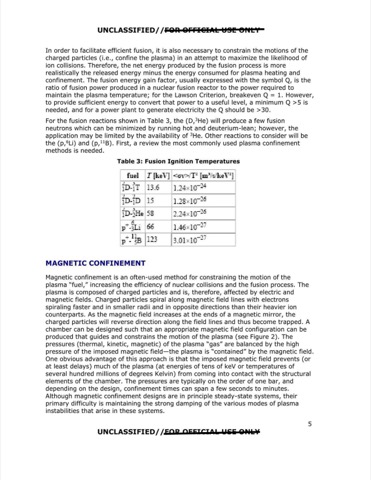
For the fusion reactions shown in Table 3, the (D,3He) will produce a few fusion
neutrons which can be minimized by running hot and deuterium-lean; however, the
application may be limited by the availability of 3He. Other reactions to consider will be
the (p,©Li) and (p, 11B). First, a review the most commonly used plasma confinement
methods is needed.
Table 3: Fusion Ignition Temperatures
fuel I [keV] <ov>/T* [m's/keV"]
13.6
1.24×10--+
15
1.28×10⁻²⁶
•He
58
2.24×10⁻²⁶
66
1.46×10⁻²⁷
P
123
3.01×10⁻²⁷
MAGNETIC CONFINEMENT
Magnetic confinement is an often-used method for constraining the motion of the
plasma "fuel," increasing the efficiency of nuclear collisions and the fusion process. The
plasma is composed of charged particles and is, therefore, affected by electric and
magnetic fields. Charged particles spiral along magnetic field lines with electrons
spiraling faster and in smaller radii and in opposite directions than their heavier ion
counterparts. As the magnetic field increases at the ends of a magnetic mirror, the
charged particles will reverse direction along the field lines and thus become trapped. A
chamber can be designed such that an appropriate magnetic field configuration can be
produced that quides and constrains the motion of the plasma see Figure 2. The
pressures (thermal, kinetic, magnetic) of the plasma "gas" are balanced by the high
pressure of the imposed magnetic field-the plasma is "contained" by the magnetic field.
One obvious advantage of this approach is that the imposed magnetic field prevents (or
at least delays) much of the plasma (at energies of tens of keV or temperatures of
several hundred millions of degrees Kelvin) from coming into contact with the structural
elements of the chamber. The pressures are typically on the order of one bar, and
depending on the design, confinement times can span a few seconds to minutes.
Although magnetic confinement designs are in principle steady-state systems, their
primary difficulty is maintaining the strong damping of the various modes of plasma
instabilities that arise in these systems.
5
UNCLASSIFIED/ /EOR OFEICI
AL USE ONLY