Text of page 26
UNCLASSIFIED/TTOR OFF TETAL USE ONLY
Chapter 3: Aneutronic Nuclear Fusion Schemes
Up to now, the fusion schemes described have the lowest fusion initiation temperatures
ranging from 10 million kelvin to about 300 million kelvin. Most of the energy released
from the fusion schemes in Figure 7 also release more than 80% of their energy in
neutrons. Neutrons are difficult to shield and present a safety concern for the crew of a
fusion-powered spacecraft. Unlike charged particles, their energy cannot easily be
converted into electricity using magnetohydrodynamic generators and they cannot be
focused into a propulsion beam to generate thrust. As a result, aneutronic fusion
schemes have been explored for possible use in space propulsion. The schemes with
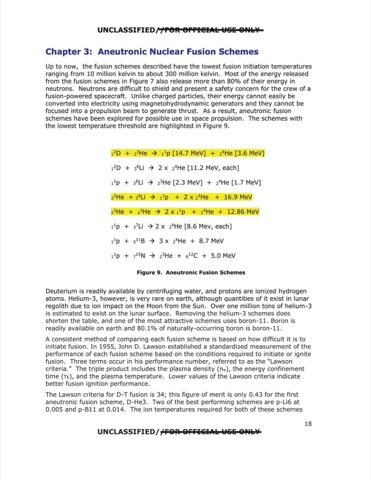
the lowest temperature threshold are highlighted in Figure 9.
12D + 23He → 1'p [14.7 MeV] + 24He [3.6 MeV]
12D + 36Li → 2 × 2*He [11.2 MeV, each]
11p + 36Li → 23He [2.3 MeV] + 2*He [1.7 MeV]
23He + 36Li → 11p + 2x2*He + 16.9 MeV
23He + 23He → 2 x 11p + 2*He + 12.86 MeV
1'p + 3'Li → 2 x 2*He [8.6 Mev, each]
14p + 511B → 3 × 24He + 8.7 MeV
11p + 715N → 23He + 612C + 5.0 MeV
Figure 9. Aneutronic Fusion Schemes
Deuterium is readily available by centrifuging water, and protons are ionized hydrogen
atoms. Helium-3, however, is very rare on earth, although quantities of it exist in lunar
regolith due to ion impact on the Moon from the Sun. Over one million tons of helium-3
is estimated to exist on the lunar surface. Removing the helium-3 schemes does
shorten the table, and one of the most attractive schemes uses boron-11. Boron is
readily available on earth and 80.1% of naturally-occurring boron is boron-11.
A consistent method of comparing each fusion scheme is based on how difficult it is to
initiate fusion. In 1955, John D. Lawson established a standardized measurement of the
performance of each fusion scheme based on the conditions required to initiate or ignite
fusion. Three terms occur in his performance number, referred to as the "Lawson
criteria." The triple product includes the plasma density (ne), the energy confinement
time (TE), and the plasma temperature. Lower values of the Lawson criteria indicate
better fusion ignition performance.
The Lawson criteria for D-T fusion is 34; this figure of merit is only 0.43 for the first
aneutronic fusion scheme, D-He3. Two of the best performing schemes are p-Li6 at
0.005 and p-B11 at 0.014. The ion temperatures required for both of these schemes
18
UNCLASSIFIED//FOR OFFICIAL USE ONLY