Text of page 22
UNCLASSIFIED/TFOR OFFICIAL USE ONLY
electric current. The ion charge is given in the equation as e. MHD generators have
been proposed for highly efficient generation of electricity from the combustion of coal,
for example. On a spacecraft, MHD generators can generate power from both ions and
electrons, which deflect in opposite directions due to the magnetic field.
Even if the ion energy cannot be converted directly into electricity, neutrons or ions can
be used to heat up a propellant gas to provide thrust. Hydrogen gas would be the most
efficient propellant for fusion reactions producing neutrons because the neutron energy
is easily absorbed through collisions with the hydrogen nuclei.
Propulsion fusion reactors, however, still generate radiation, including neutrons, which
pose a health hazard for the crew of any spacecraft. By carrying hydrogen propellant
and locating the crew as far away as possible from the fusion reactor, some degree of
shielding is possible.
While fusion reactors have the potential to produce incredible amounts of energy from
relatively inexpensive fuel (deuterium, tritium, helium-3), the problems of initiating,
controlling, and sustaining the fusion reaction remain unsolved.
FUSION INITIATION METHODS
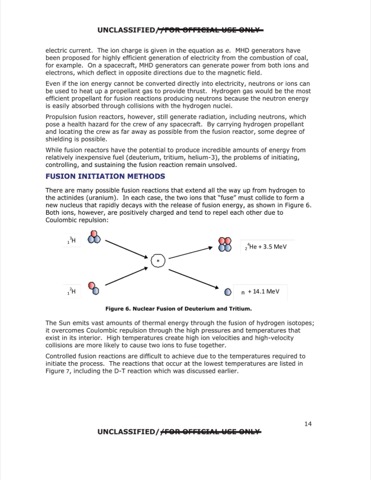
There are many possible fusion reactions that extend all the way up from hydrogen to
the actinides (uranium). In each case, the two ions that "fuse" must collide to form a
new nucleus that rapidly decays with the release of fusion energy, as shown in Figure 6.
Both ions, however, are positively charged and tend to repel each other due to
Coulombic repulsion:
1 H
2 He + 3.5 MeV
n + 14.1 MeV
Figure 6. Nuclear Fusion of Deuterium and Tritium.
The Sun emits vast amounts of thermal energy through the fusion of hydrogen isotopes;
it overcomes Coulombic repulsion through the high pressures and temperatures that
exist in its interior. High temperatures create high ion velocities and high-velocity
collisions are more likely to cause two ions to fuse together.
Controlled fusion reactions are difficult to achieve due to the temperatures required to
initiate the process. The reactions that occur at the lowest temperatures are listed in
Figure 7, including the D-T reaction which was discussed earlier.
14
UNCLASSIFIED//FOR OFFICIAL USE ONLY