DOW-UAP-D145

AAWSAP DIRD, Aneutronic Fusion Propulsion I, November 2010, page 19

One page of a U.S. government record released under PURSUE, shown on its own with its text. The record page has the whole document, its catalog details and the scan.

Page
19 of 50
Agency
Department of War
Released
Release 06, September 18, 2026

Text of page 19

UNCLASSIFIED//FOR OFFICIAL USE ONLY - Payload Liquid H, Tank Turbopump Nuclear Fuel Assembly Laval Nozzle Figure 4. Nuclear Fission Rocket Design. Nuclear fission rockets had numerous problems. The fission of uranium-235 emits about 200 MeV for every nucleus that undergoes fission. Approximately 11% of this energy is in the form of neutrinos and is unrecoverable. Approximately 4.8 MeV shows up as kinetic energy in the two or more neutrons that are created for every fission. At least one neutron must be absorbed by another U-355 nucleus and cause fission in order for a chain reaction to be sustained. Most of the energy goes into the kinetic energy of large fission fragments that are created by the breakup of the U-235 nucleus. Fission products are highly radioactive and may be ejected out with the rocket exhaust. Neutrons pose a radiation hazard to any human close to the rocket when it operates. In the tests of the NERVA series of rockets, on at least one occasion, pieces of radioactive material were ejected over a small region of the Nevada Test Site and had to be manually retrieved. On the positive side, the NERVA rockets created large amounts of thrust, and the energy within the reactor was more than sufficient to send its payload to the desired location in the USSR. This prompted scientists to consider the use of thermal fission reactors for use in space exploration, although the persistent problem of radiation exposure to the crew remained unresolved. Two classical designs were proposed. In one design, a reactor would be constructed as shown in Figure 4, and liquid hydrogen propellant would be passed through the reactor to create a supersonic exhaust and to provide thrust. The hydrogen fuel would be located between the reactor and the crew to serve as a radiation shield for neutrons produced during fission. The spacecraft would be elongated to move the crew as far away as possible from the reactor, taking advantage of the 1/2 attenuation of radiation with distance from a source. 11 UNCLASSIFIED//FOR OFFICIAL USE ONLY

Machine-read (OCR) from the scan by this archive; it can contain errors. The scan is the record.
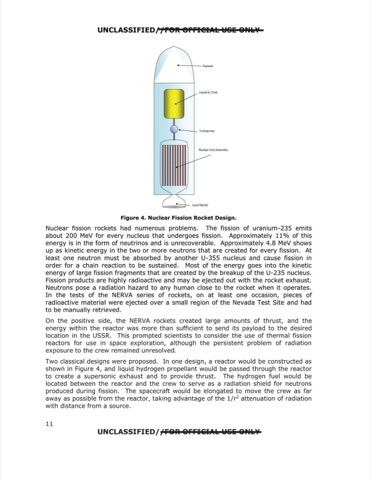
Image from page 19 of DOW-UAP-D145, as released by war.gov
Image from page 19 of the PDF. Open the scan to see the whole page.

Cite this page

U.S. Department of War. "AAWSAP DIRD, Aneutronic Fusion Propulsion I, November 2010" (DOW-UAP-D145). PURSUE Release 06, U.S. Department of War, September 18, 2026. https://www.war.gov/medialink/ufo/sept-18/release-06/assets/DOW-UAP-D145_AAWSAP-DIRD-Aneutronic-Fusion-Propulsion-I-November-1-2010.pdf. Declassified UAP, page 19, https://declassifieduap.org/r/dow-uap-d145-aawsap-dird-aneutronic-fusion-propulsion-i-november-2010/p/19. Accessed November 28, 2026.

This address shows page 19 on its own; /r/dow-uap-d145-aawsap-dird-aneutronic-fusion-propulsion-i-november-2010?page=19 opens the same page in the full reader. Both stay. How to cite.