Text of page 13
UNCLASSIFIED/TTOR OFFFETAL USE ONLY
COMPARISON OF SPECIFIC IMPULSE FOR VARIOUS ROCKET
DESIGNS
Chemical Rockets
Chemical rockets burn solid or liquid propellant. The exhaust gas exits the rocket
through a Laval nozzle and generates thrust. Figure 1 provided the outline of a liquid-
fueled rocket using liquid hydrogen as the fuel and liquid oxygen (LOX) to combust the
fuel. Unlike turbofan and RAM engines, rockets are not airbreathing and must carry
their own oxidizer.
The Laval nozzle is a principle component of chemical rockets; its design is based on
compressible fluid flow theory. 4 In general, the nozzle is made up of contoured
convergent-divergent cross sections. Conical cross sections are also sometimes used.
Its purpose is to transform pressure energy into kinetic energy. Nuclear fusion rockets
may also make use of Laval nozzles by heating up a liquid propellant and ejecting it as
a supersonic gas. In subsonic flow, fluid can only be accelerated by decreasing the
cross-sectional area of the duct section that it is traveling through, as in a Venturi tube.
Once the velocity in a fluid reaches the speed of sound (Mach 1), the fluid can continue
to accelerate only if it is expanded. The Laval nozzle combines a converging section
where the flow is subsonic, a throat where the flow is accelerated to sonic speed (Mach
1), and a diverging cone where the flow is accelerated to supersonic speed.
performance of a rocket is based on its thrust, where T = (dm/dt) x Vexhaust, and by
maximizing the exit velocity, the thrust reaches a maximum. The pressure of the
combusting gases in the combustion chamber directly affect the amount of thrust that
the rocket can achieve.
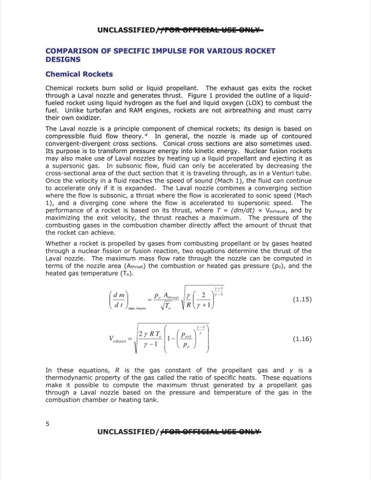
Whether a rocket is propelled by gases from combusting propellant or by gases heated
through a nuclear fission or fusion reaction, two equations determine the thrust of the
Laval nozzle. The maximum mass flow rate through the nozzle can be computed in
terms of the nozzle area (Athroat) the combustion or heated gas pressure (po), and the
heated gas temperature (To).
y +1
1y -1
(1.15)
Vexhaust =
2V RT.
V -1
(1.16)
In these equations, R is the gas constant of the propellant gas and y is a
thermodynamic property of the gas called the ratio of specific heats. These equations
make it possible to compute the maximum thrust generated by a propellant gas
through a Laval nozzle based on the pressure and temperature of the gas in the
combustion chamber or heating tank.
5
UNCLASSIFIED/+FOR OFFICIAL USE ONLY