DOW-UAP-D144

AAWSAP DIRD, Cockpits in the Era of Breakthrough Flight, November 2010, page 8

One page of a U.S. government record released under PURSUE, shown on its own with its text. The record page has the whole document, its catalog details and the scan.

Page
8 of 57
Agency
Department of War
Released
Release 06, September 18, 2026

Text of page 8

UNCLASSIFIED//FOR eFFrEIAL USE ONLY a single joystick with six degrees of freedom, some sort of gesture-based system, or one that has those degrees of freedom dispersed across multiple pilot inputs (e.g., head motion, legs and feet, and arms and hands) remains open for future study. As a provisional baseline, this report chooses the option of having a pair of six-degree-of- freedom joysticks, one for both the left and right hands and located at the edge of the cockpit chair's arm rests. Three equally available rectilinear axes of motion Three equally available rotational axes of motion Figure 1. Six Independent Degrees of Freedom. [Graphic: A. Szames] Note: the vehicle shown is strictly hypothetical and is a combination of three 1960s science fiction vehicles: Seaview submarine, Galileo shuttle, and Amtronic car. Similar to requiring new control methods, new display methods are also required to convey more information than in legacy cockpits. In addition to the complete six degrees of freedom, these motions will take place near the Earth's surface, in orbit, and in deep space. A key difference spanning those regimes is the traditional role played by a gravitational field as a reference for orientation and motion. Since a gravitational reference will not always be present, and yet is extremely important when it is present, the new display system must accommodate all regimes in a way that feels natural to the pilots. These particular challenges are addressed in the section on Mixed Operational Regimes. Separation of Internal and External Environments Probably the most significant and perplexing difference for breakthrough-era cockpits is that the sensations of motion inside the vehicle will not necessarily match the motion of the vehicle itself. This is both a consequence of the method of propulsion as well as cockpit features designed to ensure crew survival. 3 UNCLASSIFIED//FOR OFFICIAL VISE ONLY

Machine-read (OCR) from the scan by this archive; it can contain errors. The scan is the record.
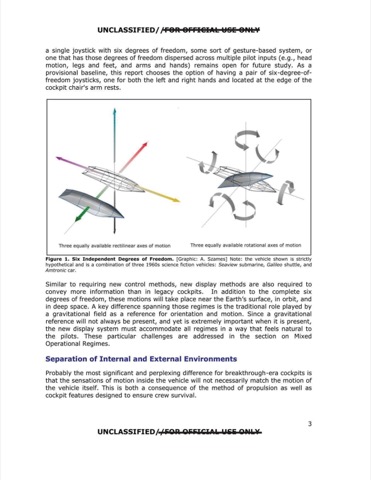
Image from page 8 of DOW-UAP-D144, as released by war.gov
Image from page 8 of the PDF. Open the scan to see the whole page.

Cite this page

U.S. Department of War. "AAWSAP DIRD, Cockpits in the Era of Breakthrough Flight, November 2010" (DOW-UAP-D144). PURSUE Release 06, U.S. Department of War, September 18, 2026. https://www.war.gov/medialink/ufo/sept-18/release-06/assets/DOW-UAP-D144_AAWSAP-DIRD-Cockpits-in-the-Era-of-Breakthrough-Flight-November-1-2010.pdf. Declassified UAP, page 8, https://declassifieduap.org/r/dow-uap-d144-aawsap-dird-cockpits-in-the-era-of-breakthrough-flight-november-2010/p/8. Accessed November 28, 2026.

This address shows page 8 on its own; /r/dow-uap-d144-aawsap-dird-cockpits-in-the-era-of-breakthrough-flight-november-2010?page=8 opens the same page in the full reader. Both stay. How to cite.