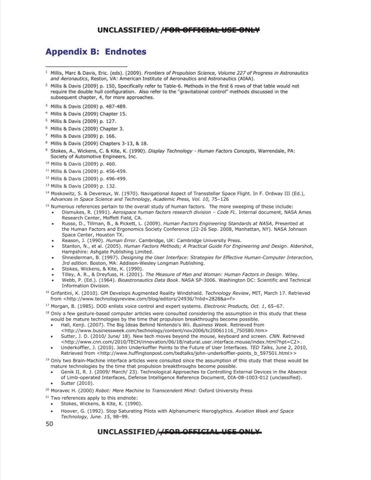
Text of page 55
UNCLASSIFIED//FOR eFfFerAL USE ONLY
Appendix B: Endnotes
1 Mill Monast a Re ton, Veds) erican Frontie of Propulsion Science, volume 247 A Progress in Astronautics
2 Millis & Davis (2009) p. 150, Specifically refer to Table-6. Methods in the first 6 rows of that table would not
require the double hull configuration. Also refer to the "gravitational control" methods discussed in the
subsequent chapter, 4, for more approaches.
3 Millis & Davis (2009) p. 487-489.
4 Millis & Davis (2009) Chapter 15.
5 Millis & Davis (2009) p. 127.
6 Millis & Davis (2009) Chapter 3.
7 Millis & Davis (2009) p. 166.
8 Millis & Davis (2009) Chapters 3-13, & 18.
9 Stokes, A., Wickens, C. & Kite, K. (1990). Display Technology - Human Factors Concepts, Warrendale, PA:
Society of Automotive Engineers, Inc.
10 Millis & Davis (2009) p. 460.
11 Millis & Davis (2009) p. 456-459.
12 Millis & Davis (2009) p. 496-499.
13 Millis & Davis (2009) p. 132.
14 Moskowitz, S. & Devereux, W. (1970). Navigational Aspect of Transstellar Space Flight. In F. Ordway III (Ed.),
Advances in Space Science and Technology, Academic Press, Vol. 10, 75-126
15 Numerous references pertain to the overall study of human factors. The more sweeping of these include:
•
Dismukes, R. (1991). Aerospace human factors research division - Code FL. Internal document, NASA Ames
Research Center, Moffett Field, CA.
• Russo, D., Tillman, B., & Pickett, L. (2009). Human Factors Engineering Standards at NASA, Presented at
the Human Factors and Ergonomics Society Conference (22-26 Sep. 2008, Manhattan, NY). NASA Johnson
Space Center, Houston TX.
: Reason, N. 6701, (2005). Human Fabris Me US, A Pride a verse engineering and Design. Aldershot,
Hampshire: Ashgate Publishing Limited.
• Shneiderman, B. (1997). Designing the User Interface: Strategies for Effective Human-Computer Interaction,
3rd edition. Boston, MA: Addison-Wesley Longman Publishing.
• Stokes, Wickens, & Kite, K. (1990).
• •
Tilley, A. R., & Dreyfuss, H. (2001). The Measure of Man and Woman: Human Factors in Design. Wiley.
Webb, P. (Ed.). (1964). Bioastronautics Data Book. NASA SP-3006. Washington DC: Scientific and Technical
Information Division.
16 Grifantini, K. (2010). GM Develops Augmented Reality Windshield. Technology Review, MIT, March 17. Retrieved
from <http://www.technologyreview.com/blog/editors/24936/?nlid=2828&a=f>
17 Morgan, B. (1985). DOD enlists voice control and expert systems. Electronic Products, Oct. 1, 65-67.
18 Only a few gesture-based computer articles were consulted considering the assumption in this study that these
would be mature technologies by the time that propulsion breakthroughs become possible.
• Hall, Kenji. (2007). The Big Ideas Behind Nintendo's Wii. Business Week. Retrieved from
<http://www.businessweek.com/technology/content/nov2006/tc20061116_750580.htm>
• Sutter, J. D. (2010/ June/ 18). New tech moves beyond the mouse, keyboard and screen. CNN. Retrieved
<http://www.cnn.com/2010/TECH/innovation/06/18/natural.user.interface.mouse/index.html?hpt=C2>.
• Underkoffler, J. (2010). John Underkoffler Points to the Future of User Interfaces. TED Talks, June 2, 2010,
Retrieved from <http://www.huffingtonpost.com/tedtalks/john-underkoffler-points_b_597501.html>>
19 Only two Brain-Machine interface articles were consulted since the assumption of this study that these would be
mature technologies by the time that propulsion breakthroughs become possible.
• Genik II, R. J. (2009/ March/ 23). Technological Approaches to Controlling External Devices in the Absence
of Limb-operated Interfaces, Defense Intelligence Reference Document, DIA-08-1003-012 (unclassified).
• Sutter (2010).
20 Moravec H. (2000) Robot: Mere Machine to Transcendent Mind: Oxford University Press
21 Two references apply to this endnote:
• Stokes, Wickens, & Kite, K. (1990).
• Hoover, G. (1992). Stop Saturating Pilots with Alphanumeric Hieroglyphics. Aviation Week and Space
Technology, June. 15, 98-99.
50
UNCLASSIFIED //FOR OFFICIAL VISE ONLY