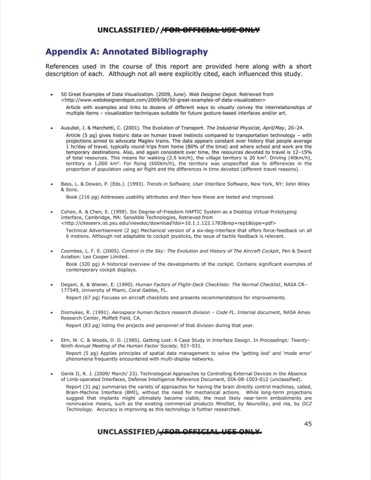
Text of page 50
UNCLASSIFIED/ /TeR eFFIETAL USE ONLY
Appendix A: Annotated Bibliography
References used in the course of this report are provided here along with a short
description of each. Although not all were explicitly cited, each influenced this study.
• 50 Great Examples of Data Visualization. (2009, June). Web Designer Depot. Retrieved from
<http://www.webdesignerdepot.com/2009/06/50-great-examples-of-data-visualization>
Article with examples and links to dozens of different ways to visually convey the interrelationships of
multiple items - visualization techniques suitable for future gesture-based interfaces and/or art.
• Ausubel, J. & Marchetti, C. (2001). The Evolution of Transport. The Industrial Physicist, April/May, 20-24.
Article (5 pg) gives historic data on human travel instincts compared to transportation technology - with
projections aimed to advocate Maglev trains. The data appears constant over history that people average
1 hr/day of travel, typically round trips from home (80% of the time) and where school and work are the
temporary destinations. Also, and again consistent over time, the resources devoted to travel is 12-15%
Bass, L. & Dewan, P. (Eds.). (1993). Trends in Software, User Interface Software, New York, NY: John Wiley
& Sons.
Book (216 pg) Addresses usability attributes and then how these are tested and improved.
• Cohen, A. & Chen, E. (1999). Six Degree-of-Freedom HAPTIC System as a Desktop Virtual Prototyping
Interface, Cambridge, MA: SensAble Technologies, Retrieved from
<http://citeseerx.ist.psu.edu/viewdoc/download?doi=10.1.1.122.1783&rep=rep1&type=pdf>
Technical Advertisement (2 pg) Mechanical version of a six-deg-interface that offers force-feedback on all
6 motions. Although not adaptable to cockpit joysticks, the issue of tactile feedback is relevant.
• Coombes, L. F. E. (2005). Control in the Sky: The Evolution and History of The Aircraft Cockpit, Pen & Sword
Aviation: Leo Cooper Limited.
Book (320 pg) A historical overview of the developments of the cockpit. Contains significant examples of
contemporary cockpit displays.
Degani, A. & Wiener, E. (1990). Human Factors of Flight-Deck Checklists: The Normal Checklist, NASA CR-
177549, University of Miami, Coral Gables, FL.
Report (67 pg) Focuses on aircraft checklists and presents recommendations for improvements.
•
Dismukes, R. (1991). Aerospace human factors research division - Code FL. Internal document, NASA Ames
Research Center, Moffett Field, CA.
Report (83 pg) listing the projects and personnel of that division during that year.
•
Elm, W. C. & Woods, D. D. (1985). Getting Lost: A Case Study in Interface Design. In Proceedings: Twenty-
Ninth Annual Meeting of the Human Factor Society, 927-931.
Report (5 pg) Applies principles of spatial data management to solve the 'getting lost' and 'mode error'
phenomena frequently encountered with multi-display networks.
• Genik II, R. J. (2009/ March/ 23). Technological Approaches to Controlling External Devices in the Absence
of Limb-operated Interfaces, Defense Intelligence Reference Document, DIA-08-1003-012 (unclassified).
Report (31 pg) summaries the variety of approaches for having the brain directly control machines, called,
Brain-Machine Interface (BMI), without the need for mechanical actions. While long-term projections
suggest that implants might ultimately become viable, the most likely near-term embodiments are
noninvasive means, such as the existing commercial products MindSet, by NeuroSky, and nia, by OCZ
Technology. Accuracy is improving as this technology is further researched.
45
UNCLASSIFIED //FOR OFFICIAL VISE ONLY