DOW-UAP-D144

AAWSAP DIRD, Cockpits in the Era of Breakthrough Flight, November 2010, page 42

One page of a U.S. government record released under PURSUE, shown on its own with its text. The record page has the whole document, its catalog details and the scan.

Page
42 of 57
Agency
Department of War
Released
Release 06, September 18, 2026

Text of page 42

UNCLASSIFIED//TOR OFFICIAL USE ONLY Copying the general organization of the other major panels, this tall and narrow enunciator is divided into three sections: • External Alarms (Upper Left): Alarm indicators corresponding to the most life- threatening conditions (limit of 4 to 10) that could occur external to the vehicle, such as impending collisions, hazardous radiation, or other critical situations. • Vehicle Alarms (Upper Right): Alarm indicators corresponding to the most life- threatening conditions (limit of 4 to 10) that could occur internally from the vehicle itself, such as catastrophic equipment malfunctions. • Cabin Alarms (Bottom): Alarm indicators corresponding to the most life- threatening conditions of the cabin's life support (limit of 4 to 10), such as loss of air pressure, excessive internal g's, temperature extremes, or pilot health conditions. Emergency Response Panel The narrow vertical panel between the center and right panel is the emergency response panel: a fixed series of buttons for preprogrammed emergency responses, including at least one variable button tied to the recommendations on the flight assist response his serora meme at perfer to tout needing aditional in yes trom the pites provisional set of these preprogrammed emergency response buttons is as follows: • Evasive collision avoidance. • Escape to safe loiter position. • Get medical assistance. • Effect automated repair. • Return to base. • Flight-assist recommendation. One of the emergency response panel buttons is to select whatever response option is currently displayed on the assistant panel, while the other emergency response buttons are fixed functions. Flight-Mode Panel Because selecting any of these emergency responses will change the flight mode into "fully autonomous" mode, the flight-mode panel is between the emergency response panel and the survival enunciator. Because the flight mode is a critical piece of information, it is also located between the vector motion display and the vehicle status panel. In aircraft, the flight-mode controls are often on the glare shield, but in the breakthrough-era craft, there will not be a need for a glare shield. The light in the cabin is only from the display systems whose brightness can be set to prevent glare on the consoles. 37 UNCLASSIFIED//FOR OFFICIAL VICE ONLY

Machine-read (OCR) from the scan by this archive; it can contain errors. The scan is the record.
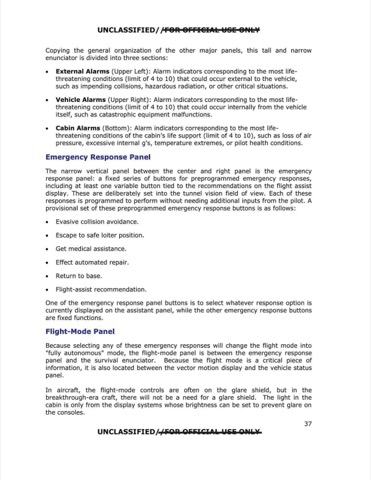
Image from page 42 of DOW-UAP-D144, as released by war.gov
Image from page 42 of the PDF. Open the scan to see the whole page.

Cite this page

U.S. Department of War. "AAWSAP DIRD, Cockpits in the Era of Breakthrough Flight, November 2010" (DOW-UAP-D144). PURSUE Release 06, U.S. Department of War, September 18, 2026. https://www.war.gov/medialink/ufo/sept-18/release-06/assets/DOW-UAP-D144_AAWSAP-DIRD-Cockpits-in-the-Era-of-Breakthrough-Flight-November-1-2010.pdf. Declassified UAP, page 42, https://declassifieduap.org/r/dow-uap-d144-aawsap-dird-cockpits-in-the-era-of-breakthrough-flight-november-2010/p/42. Accessed November 28, 2026.

This address shows page 42 on its own; /r/dow-uap-d144-aawsap-dird-cockpits-in-the-era-of-breakthrough-flight-november-2010?page=42 opens the same page in the full reader. Both stay. How to cite.