DOW-UAP-D144

AAWSAP DIRD, Cockpits in the Era of Breakthrough Flight, November 2010, page 39

One page of a U.S. government record released under PURSUE, shown on its own with its text. The record page has the whole document, its catalog details and the scan.

Page
39 of 57
Agency
Department of War
Released
Release 06, September 18, 2026

Text of page 39

UNCLASSIFIED//FOR eFFFErAL USE ONLY Interactive Assist This is a further automated augmentation of the prior flight mode. In this case, following commands from the pilot (voice, gesture, or thought), the pilot can request for the flight assistant to fly the vehicle as desired. In this mode, it is most likely that the pilot will not be touching the joysticks, but rather issuing "drive to" commands to the automated system. Fully Autonomous In the event that the pilot is incapacitated or performing non-flight tasks, the fully autonomous mode flies the vehicle in whatever flight command mode was last entered. This means that the system follows through with previously entered commands, including a selection of preset emergency responses, such as "returning to base" or "flying to the nearest medical facility." These emergency response functions may have a dedicated physical panel. PHYSICAL DISPLAYS In keeping with human-factors lessons, particularly the use of physical analogies of human perception, the critical displays and controls will be anchored in physical hardware in fixed locations. The primary reason for providing an actual physical set of displays and controls is to minimize errors during stressful situations. This includes tunnel vision, mode errors, and keyhole errors. The controls also include tactile feedback. Following the precedents of modern flight decks and human-factors lessons, each of the panels will have a dominant function as identified in Figure 14. Although the look and feel of these panels has not yet been conjectured, their likely functions and features can be estimated. Navigation Display Survival Enunciator Vector Motion Display Flight Mode R → Cabin Control Flight Assist Interactive Display Key Pad Emergency Response Vehicle Status Comm. Control External Sensing Pullout Keyboard Internal Conditions Periphery Motion Display Dual Six-Degree Joysticks Periphery Motion Display Figure 14. Functional Designation of Physical Cockpit Panels. Basic layout of the physical displays and controls. The function of each is described in the text. [Credit: M. Millis] 34 UNCLASSIFIED//FOR OFFICIAL USE-OALY

Machine-read (OCR) from the scan by this archive; it can contain errors. The scan is the record.
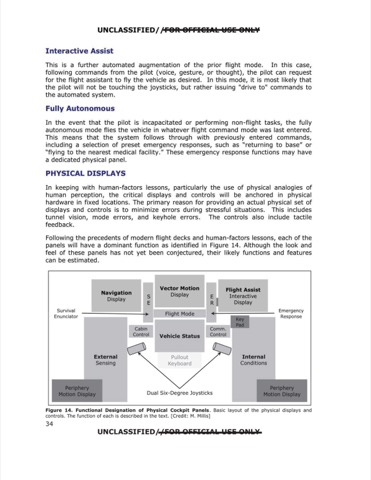
Image from page 39 of DOW-UAP-D144, as released by war.gov
Image from page 39 of the PDF. Open the scan to see the whole page.

Cite this page

U.S. Department of War. "AAWSAP DIRD, Cockpits in the Era of Breakthrough Flight, November 2010" (DOW-UAP-D144). PURSUE Release 06, U.S. Department of War, September 18, 2026. https://www.war.gov/medialink/ufo/sept-18/release-06/assets/DOW-UAP-D144_AAWSAP-DIRD-Cockpits-in-the-Era-of-Breakthrough-Flight-November-1-2010.pdf. Declassified UAP, page 39, https://declassifieduap.org/r/dow-uap-d144-aawsap-dird-cockpits-in-the-era-of-breakthrough-flight-november-2010/p/39. Accessed November 28, 2026.

This address shows page 39 on its own; /r/dow-uap-d144-aawsap-dird-cockpits-in-the-era-of-breakthrough-flight-november-2010?page=39 opens the same page in the full reader. Both stay. How to cite.