DOW-UAP-D144

AAWSAP DIRD, Cockpits in the Era of Breakthrough Flight, November 2010, page 25

One page of a U.S. government record released under PURSUE, shown on its own with its text. The record page has the whole document, its catalog details and the scan.

Page
25 of 57
Agency
Department of War
Released
Release 06, September 18, 2026

Text of page 25

UNCLASSIFIED//FOR eFFrEIAL USE ONLY Fields of View There is a difference between what humans are physically capable of seeing and where they naturally concentrate their attention. Using a reference point that is straight ahead and level with the eyes, the normal full field of view extends laterally (left/right) +100° , upward about +60° , and downward about -75° . Of course, turning the head can extend the lateral reach directly behind, but that rearward view would be in the edge of periphery vision. This full span, however, is not where humans normally direct their attention. With the head in a fixed position, the normal field of view spans left/right 100°. The periphery is most sensitive to motion even when discrete images cannot be resolved. The region shown that spans roughly #60° is the area that can be easily scanned by moving the eyes and whose information can be mentally processed in parallel. A much narrower field, about 6° , is where humans can discern details and begin processing information serially. This zone can be aimed anywhere in the normal field of view. Finally, the region of focus where alphanumerics can be read is only about +2° , which corresponds to only one square inch at a distance of 2 feet. Another characteristic of human vision is the tendency to fixate in the upper right corner of a given display. In the figure insert, the percentages shown refer to the proportion of total time that the eye tends to fixate on those regions. Normal field of view Area where details can be discerned (Macula) 20% 13% 47% 20% Area of easy eye motion scanning Figure 9. Human Fields of View. [Graphic: A. Szames] 20 UNCLASSIFIED//FOR OFFICIAL VISE ONLY

Machine-read (OCR) from the scan by this archive; it can contain errors. The scan is the record.
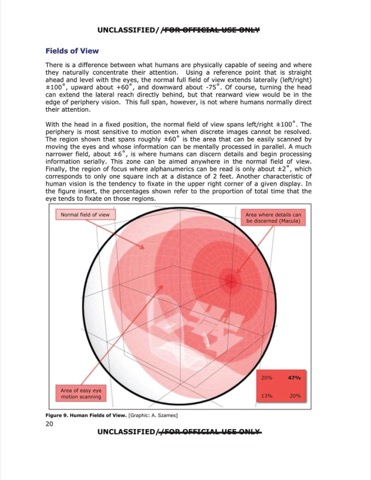
Image from page 25 of DOW-UAP-D144, as released by war.gov
Image from page 25 of the PDF. Open the scan to see the whole page.

Cite this page

U.S. Department of War. "AAWSAP DIRD, Cockpits in the Era of Breakthrough Flight, November 2010" (DOW-UAP-D144). PURSUE Release 06, U.S. Department of War, September 18, 2026. https://www.war.gov/medialink/ufo/sept-18/release-06/assets/DOW-UAP-D144_AAWSAP-DIRD-Cockpits-in-the-Era-of-Breakthrough-Flight-November-1-2010.pdf. Declassified UAP, page 25, https://declassifieduap.org/r/dow-uap-d144-aawsap-dird-cockpits-in-the-era-of-breakthrough-flight-november-2010/p/25. Accessed November 28, 2026.

This address shows page 25 on its own; /r/dow-uap-d144-aawsap-dird-cockpits-in-the-era-of-breakthrough-flight-november-2010?page=25 opens the same page in the full reader. Both stay. How to cite.