DOW-UAP-D144

AAWSAP DIRD, Cockpits in the Era of Breakthrough Flight, November 2010, page 15

One page of a U.S. government record released under PURSUE, shown on its own with its text. The record page has the whole document, its catalog details and the scan.

Page
15 of 57
Agency
Department of War
Released
Release 06, September 18, 2026

Text of page 15

UNCLASSIFIED//FOR OF AL USE ONLY Outer Hull Inner Hull Crew Safe Zone Figure 6. Inertial Frame Bias Drive and Vehicle Zones. [Credit: M. Millis] To be explicit, the physics and engineering to create such situations do not yet exist. The related physics can be categorized as still being at steps one and two of the scientific method: defining the problem and collecting data.® Among many other issues eluding discovery and resolution, major issues include momentum conservation, the role played by inertial frames, and methods to affect gravitational and inertial properties of matter and space. Secondary Consequences Pertinent to cockpit design, the normal sensations of motion inside the cockpit will likely not be the same. In contrast to the advantage of shielding the crew from harsh maneuvers, this shielding removes sensations of motion (seat-of-pants feeling) that pilots use to help judge the motion of their vehicle. This detriment is compounded by the likelihood of inducing motion sickness, since the visual cues of the vehicle's real motion will be different from that felt by the pilot. A difference between visual and vestibular cues is a cause of motion sickness. The option of allowing a certain portion of the vehicle's g-loading to be transferred to the cockpit can be considered as a mitigation strategy. Accordingly, cockpit controls to affect such changes are required. Also, it is likely that this double-hull notion would prevent direct visual contact between the occupants and the environment outside the vehicle, or perhaps distort such visual cues beyond easy interpretation. In other words, do not expect windows. Without the familiar visual and vestibular cues directly available to the pilot, it becomes vitally important for the cockpit displays to provide reliable and instinctive cues for the pilot to aptly judge the position, orientation, and motion of the vehicle. Mixed Operational Regimes A major desirable feature sought from propulsion breakthroughs is the ability to move from the surface of the Earth directly into space. This implies that the vehicle's displays and controls must readily encompass motion near the Earth's surface, ascent into space, 10 UNCLASSIFIED//FOR OFFICIAL VISE ONLY

Machine-read (OCR) from the scan by this archive; it can contain errors. The scan is the record.
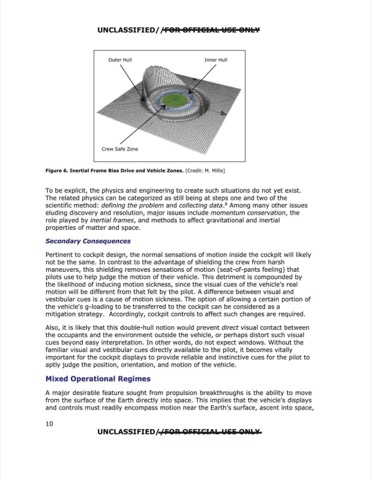
Image from page 15 of DOW-UAP-D144, as released by war.gov
Image from page 15 of the PDF. Open the scan to see the whole page.

Cite this page

U.S. Department of War. "AAWSAP DIRD, Cockpits in the Era of Breakthrough Flight, November 2010" (DOW-UAP-D144). PURSUE Release 06, U.S. Department of War, September 18, 2026. https://www.war.gov/medialink/ufo/sept-18/release-06/assets/DOW-UAP-D144_AAWSAP-DIRD-Cockpits-in-the-Era-of-Breakthrough-Flight-November-1-2010.pdf. Declassified UAP, page 15, https://declassifieduap.org/r/dow-uap-d144-aawsap-dird-cockpits-in-the-era-of-breakthrough-flight-november-2010/p/15. Accessed November 28, 2026.

This address shows page 15 on its own; /r/dow-uap-d144-aawsap-dird-cockpits-in-the-era-of-breakthrough-flight-november-2010?page=15 opens the same page in the full reader. Both stay. How to cite.