DOW-UAP-D143

AAWSAP DIRD, Laser Lightcraft Nanosatellites, November 2010, page 69

One page of a U.S. government record released under PURSUE, shown on its own with its text. The record page has the whole document, its catalog details and the scan.

Page
69 of 77
Agency
Department of War
Released
Release 06, September 18, 2026

Text of page 69

UNCLASSIFIED/T USE UNLY Tracker 8 Stabilization Electronics Inertially Stabilized Pointer/Tracker Mount •-.- •0 sensor sensor 10 error O target Beam Expander 0 HEL HEL gyrol El Az Mount drive Gimbal To achieve the high precision required for a HEL Weapon, The sensor and Beam Expander must maintain precise alignment Figure 34. HEL Beam Pointer/Tracker (courtesy of the Directed Energy Professional Society). In summary, this new architecture has only the HEL module and the beam director. All the measurement and correction functions are integrated into the beam director without increasing the number of high power components usually required in a coude path.$ The three major advantages of this architecture are as follows (see Figure 35):*** • Minimizing complexity and component count: The optical control architecture has far less than a dozen mirrors plus a turret window and two polarizers between the HEL module and the target. The resulting beam line is considerably simpler, smaller and lighter than current architectures. Almost every component in the beam line performs multiple functions, thereby dramatically reducing the component count. There is only one long-burn DM, one coarse steering mirror (CSM), one FSM, and all of these are integrated into the beam director. This approach also packages all beam control sensors, processors and drivers into the turret assembly. • End-to-End Boresight and High-Bandwidth Tracking: In this design, the HEL and track illuminating laser (TILL) trackers are integrated onto the same focal plane §§Coude is French for "elbow," meaning a beam of light is bent in a zigzag manner through an optical train. ***D. Kiel, Directed Energy Systems Symposium Short Course, Naval Post-Graduate School, Monterey, CA, 2010. 65 UNCLASSIFIED LEOR OFFICIAL USE @NLY

Machine-read (OCR) from the scan by this archive; it can contain errors. The scan is the record.
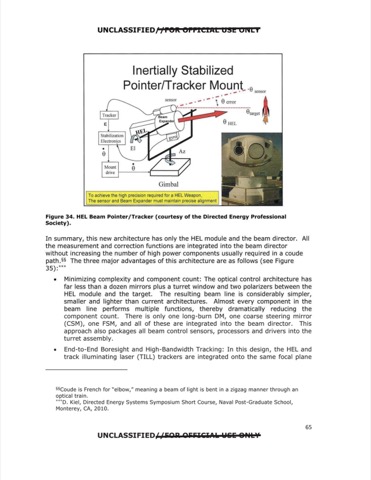
Image from page 69 of DOW-UAP-D143, as released by war.gov
Image from page 69 of the PDF. Open the scan to see the whole page.

Cite this page

U.S. Department of War. "AAWSAP DIRD, Laser Lightcraft Nanosatellites, November 2010" (DOW-UAP-D143). PURSUE Release 06, U.S. Department of War, September 18, 2026. https://www.war.gov/medialink/ufo/sept-18/release-06/assets/DOW-UAP-D143_AAWSAP-DIRD-Laser-Lightcraft-Nanosatellites-November-1-2010.pdf. Declassified UAP, page 69, https://declassifieduap.org/r/dow-uap-d143-aawsap-dird-laser-lightcraft-nanosatellites-november-2010/p/69. Accessed November 28, 2026.

This address shows page 69 on its own; /r/dow-uap-d143-aawsap-dird-laser-lightcraft-nanosatellites-november-2010?page=69 opens the same page in the full reader. Both stay. How to cite.