Text of page 66
UNCLASSIFIED TOR OTTIETAL UST UNDY
which usually result in mirror tilts (~ 0 to 400 micro-radians) and drastically
reduced beam power, thus maintaining beam power output at maximum design
value.
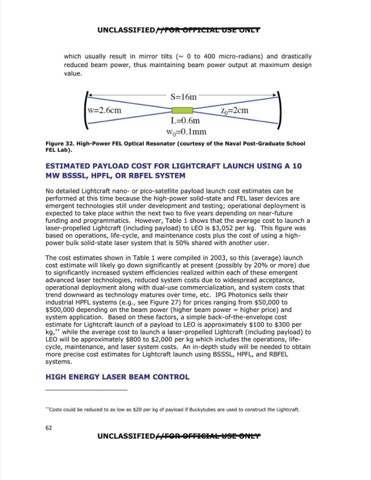
S=16m
w=2.6cm
Zo=2cm
L=0.6m
W,=0.1mm
Figure 32. High-Power FEL Optical Resonator (courtesy of the Naval Post-Graduate School
FEL Lab).
ESTIMATED PAYLOAD COST FOR LIGHTCRAFT LAUNCH USING A 10
MW BSSSL, HPFL, OR RBFEL SYSTEM
No detailed Lightcraft nano- or pico-satellite payload launch cost estimates can be
performed at this time because the high-power solid-state and FEL laser devices are
emergent technologies still under development and testing; operational deployment is
expected to take place within the next two to five years depending on near-future
funding and programmatics. However, Table 1 shows that the average cost to launch a
laser-propelled Lightcraft (including payload) to LEO is $3,052 per kg. This figure was
based on operations, life-cycle, and maintenance costs plus the cost of using a high-
power bulk solid-state laser system that is 50% shared with another user.
The cost estimates shown in Table 1 were compiled in 2003, so this (average) launch
cost estimate will likely go down significantly at present (possibly by 20% or more) due
to significantly increased system efficiencies realized within each of these emergent
advanced laser technologies, reduced system costs due to widespread acceptance,
operational deployment along with dual-use commercialization, and system costs that
trend downward as technology matures over time, etc. IPG Photonics sells their
industrial HPFL systems (e.g., see Figure 27) for prices ranging from $50,000 to
$500,000 depending on the beam power (higher beam power = higher price) and
system application. Based on these factors, a simple back-of-the-envelope cost
estimate for Lightcraft launch of a payload to LEO is approximately $100 to $300 per
kg,**
while the average cost to launch a laser-propelled Lightcraft (including payload) to
LEO will be approximately $800 to $2,000 per kg which includes the operations, life-
cycle, maintenance, and laser system costs. An in-depth study will be needed to obtain
more precise cost estimates for Lightcraft launch using BSSSL, HPFL, and RBFEL
systems.
HIGH ENERGY LASER BEAM CONTROL
**Costs could be reduced to as low as $20 per kg of payload if Buckytubes are used to construct the Lightcraft.
62
UNCLASSIFIED//FOR OFFICIAL USE ONLY