DOW-UAP-D143

AAWSAP DIRD, Laser Lightcraft Nanosatellites, November 2010, page 55

One page of a U.S. government record released under PURSUE, shown on its own with its text. The record page has the whole document, its catalog details and the scan.

Page
55 of 77
Agency
Department of War
Released
Release 06, September 18, 2026

Text of page 55

UNCLASSIFIED /TOR OFFICTAL UST UNLY • Average power limited by low thermal conductivity of host material. • Wavelengths propagate extremely well in clear weather: - Very low absorption. - Higher scattering. The requirements for high average power bulk solid-state lasers are [30]: • Efficient optical pumping of gain medium: - Flash lamp or laser diode well matched to absorption band. - Small wavelength difference between pump and lasing → low quantum defect. • Efficient heat removal from gain medium: - Improved heat removal techniques from host. - Large surface area per unit volume. - Or, large volume to store heat with low duty cycle operation. • Gain medium must retain good (correctable) optical quality. The typical properties of widely used Nd:YAG lasers are [30]: • 4 nm absorption line width. • 24% heating from quantum loss. • Saturation intensity = 3 kW/cm (at = 2% dopant). • Multi-kilowatt average power demonstrated. • Maximum average power potential ~ several hundred kilowatts: - Heat removal makes continuous running a challenge at this power. - Current high-energy SSLs produce great amounts of heat (e.g., 600 kW of electrical power in and 100 kW of beam power out equals 500 kW of waste heat). Must store the waste heat and reject it from the system at a lower rate, thus requiring storage and limited duty cycle. • Quantum defect = pump light photon energy minus laser light photon energy. The typical properties of widely used Yb:YAG lasers are [30]: • 18 nm absorption line width. • Indium gallium arsenide (InGaAs) pump laser diodes at 0.941 um wavelength: - 8.6% heating from quantum loss. • Saturation intensity ≥ 9.7 kW/cm? (at ~ 25% dopant). • Multi-kilowatt average power demonstrated. • Maximum average power potential is perhaps 5 x Nd: YAG laser. A new technology that enables the scaling-up of BSSSL beam power is a recently developed thermal management system that is used to remove and store the waste heat produced by BSSSL devices. General Atomics' Advanced Power Systems Division recently announced* that it has completed testing of an advanced thermal energy *Reported in Space War Newsletter, June 7, 2010. 51 UNCLASSIFIED//FOR OFFICIAL USE ONLY

Machine-read (OCR) from the scan by this archive; it can contain errors. The scan is the record.
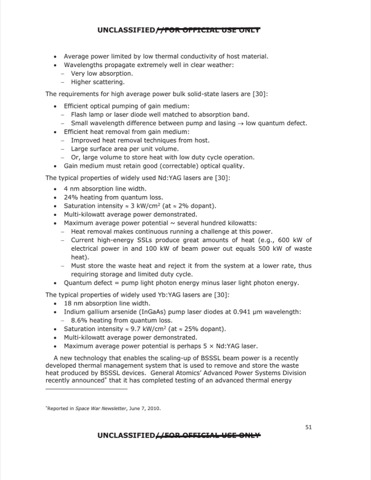
Image from page 55 of DOW-UAP-D143, as released by war.gov
Image from page 55 of the PDF. Open the scan to see the whole page.

Cite this page

U.S. Department of War. "AAWSAP DIRD, Laser Lightcraft Nanosatellites, November 2010" (DOW-UAP-D143). PURSUE Release 06, U.S. Department of War, September 18, 2026. https://www.war.gov/medialink/ufo/sept-18/release-06/assets/DOW-UAP-D143_AAWSAP-DIRD-Laser-Lightcraft-Nanosatellites-November-1-2010.pdf. Declassified UAP, page 55, https://declassifieduap.org/r/dow-uap-d143-aawsap-dird-laser-lightcraft-nanosatellites-november-2010/p/55. Accessed November 28, 2026.

This address shows page 55 on its own; /r/dow-uap-d143-aawsap-dird-laser-lightcraft-nanosatellites-november-2010?page=55 opens the same page in the full reader. Both stay. How to cite.