Text of page 39
UNCLASSIFIED FOR OFFICIAL USE ONLY
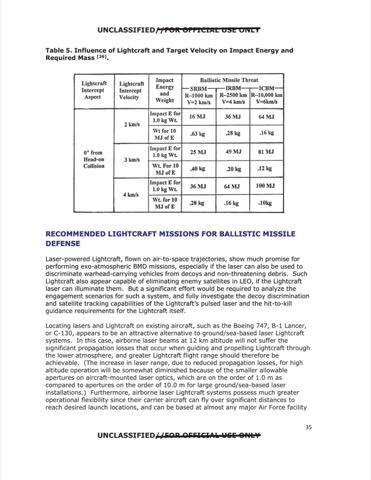
Table 5. Influence of Lightcraft and Target Velocity on Impact Energy and
Required Mass [261,
Lightcraft
Intercept
Aspect
Lighteraft
Intercept
Velocity
2 km/s
0° from
Head-on
Collision
3 km/s
4 km/s
Impact
Energy
and
Weight
Impact E for
1.0 kg Wt.
Wt for 10
MJ of E
Impact E for
1.0 kg Wt.
Wt. For 10
MJ of E
Impact E for
1.0 kg Wt.
Wt. for 10
MJ of E
Ballistic Missile Threat
- SRBM-
— IRBM-
R~1000 km
R-2500 km R~10,000 km
V=2 km/s
V=4 km/s
V=6km/s
16 MJ
36 MJ
64 MJ
.63 kg
25 MJ
.40 kg
36 MJ
.28 kg
.28 kg
49 MJ
.20 kg
64 MJ
.16 kg
16 kg
81 MJ
12 kg
100 MJ
10kg
RECOMMENDED LIGHTCRAFT MISSIONS FOR BALLISTIC MISSILE
DEFENSE
Laser-powered Lightcraft, flown on air-to-space trajectories, show much promise for
performing exo-atmospheric BMD missions, especially if the laser can also be used to
discriminate warhead-carrying vehicles from decoys and non-threatening debris. Such
Lightcraft also appear capable of eliminating enemy satellites in LEO, if the Lightcraft
laser can illuminate them. But a significant effort would be required to analyze the
engagement scenarios for such a system, and fully investigate the decoy discrimination
and satellite tracking capabilities of the Lightcraft's pulsed laser and the hit-to-kill
guidance requirements for the Lightcraft itself.
Locating lasers and Lightcraft on existing aircraft, such as the Boeing 747, B-1 Lancer,
or C-130, appears to be an attractive alternative to ground/sea-based laser Lightcraft
systems. In this case, airborne laser beams at 12 km altitude will not suffer the
significant propagation losses that occur when guiding and propelling Lightcraft through
the lower atmosphere, and greater Lightcraft flight range should therefore be
achievable. (The increase in laser range, due to reduced propagation losses, for high
altitude operation will be somewhat diminished because of the smaller allowable
apertures on aircraft-mounted laser optics, which are on the order of 1.0 m as
compared to apertures on the order of 10.0 m for large ground/sea-based laser
installations.) Furthermore, airborne laser Lightcraft systems possess much greater
operational flexibility since their carrier aircraft can fly over significant distances to
reach desired launch locations, and can be based at almost any major Air Force facility
35
UNCLASSIFIED//FOR OFFICIAL USE ONLY