DOW-UAP-D143

AAWSAP DIRD, Laser Lightcraft Nanosatellites, November 2010, page 31

One page of a U.S. government record released under PURSUE, shown on its own with its text. The record page has the whole document, its catalog details and the scan.

Page
31 of 77
Agency
Department of War
Released
Release 06, September 18, 2026

Text of page 31

UNCLASSIFIEDTITOR OFFICIAL USE ONLY Chapter 3: Laser Lightcraft Weapon Mission Selection Study The objective of the Froning and Davis [26] study was to examine crucial future Air Force launch vehicle missions and select at least one that might be performed very cost-effectively by Lightcraft vehicles powered by beamed electromagnetic energy from airborne or ground/sea-based lasers. It entailed identification and analysis of promising launch vehicle missions for laser-propelled Lightcraft, and assessments of the identified and analyzed missions by experts in the mission areas. See Figure 14 and Figure 15 for Lightcraft missions that have been identified and explored. It was concluded that the most promising Air Force mission for a laser-propelled Lightcraft is the placement of Earth and space observing nanosats of up to 3 kg mass into LEO. Such a laser-propelled Lightcraft would also serve as a "Lightsat," because it would use the Lightcraft's laser propulsion optics as a telescope for observing military targets on Earth and in space. Additional estimated mass for performing the Lightsat function is no more than about 1 kg, if the Lightcraft forebody structure panels can be unfurled in orbit and used as solar power collectors. Such a Lightcraft system appears capable of reaching LEO at 1/5th to 1/10th the cost required for placing a similar Lightsat system into LEO using multistage chemical rocket systems. Ground-to-Space (Earth-to-Orbit) Pico or Nano Satellites Figure 14. Ground / Sea-to-Space Concept: Appropriate rotation of a high-energy laser beam, emanating from a ground/sea-based laser, guides and propels an integral Lightcraft pico- / nano-satellite along an ETO ascent path until orbital conditions are reached, or until beamed laser energy can no longer be transformed into Lightcraft thrust [261, 27 UNCLASSIFIED//FOR OFFICIAL USE ONLY

Machine-read (OCR) from the scan by this archive; it can contain errors. The scan is the record.
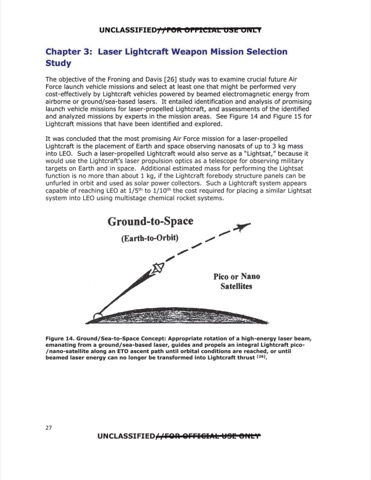
Image from page 31 of DOW-UAP-D143, as released by war.gov
Image from page 31 of the PDF. Open the scan to see the whole page.

Cite this page

U.S. Department of War. "AAWSAP DIRD, Laser Lightcraft Nanosatellites, November 2010" (DOW-UAP-D143). PURSUE Release 06, U.S. Department of War, September 18, 2026. https://www.war.gov/medialink/ufo/sept-18/release-06/assets/DOW-UAP-D143_AAWSAP-DIRD-Laser-Lightcraft-Nanosatellites-November-1-2010.pdf. Declassified UAP, page 31, https://declassifieduap.org/r/dow-uap-d143-aawsap-dird-laser-lightcraft-nanosatellites-november-2010/p/31. Accessed November 28, 2026.

This address shows page 31 on its own; /r/dow-uap-d143-aawsap-dird-laser-lightcraft-nanosatellites-november-2010?page=31 opens the same page in the full reader. Both stay. How to cite.