DOW-UAP-D143

AAWSAP DIRD, Laser Lightcraft Nanosatellites, November 2010, page 16

One page of a U.S. government record released under PURSUE, shown on its own with its text. The record page has the whole document, its catalog details and the scan.

Page
16 of 77
Agency
Department of War
Released
Release 06, September 18, 2026

Text of page 16

UNCLASSIFIED//FOR OFFICI AL USE ONLY Figure 1. Air Force X-25LR Laser Lightcraft (courtesy of F. Mead, AFRL/PRSP, Edwards AFB, CA). In the two-mode propulsion concept, a forebody aeroshell acts as an external compression surface for the airbreathing engine inlet. Affixed to the bottom of the craft is a parabolic-shaped afterbody mirror, which serves as a primary receptive optic for the laser beam and as an external plug nozzle expansion surface. The primary thrust structure is the centrally located annular shroud, which provides air through the inlet and also acts as a ring-shaped energy "absorption/propulsion" chamber for plasma formation. The air inlet is closed when the Lightcraft operates in the rocket mode. The Lightcraft is very lightweight and uses its shape to facilitate vertical flight. The craft has the appearance of a fat acorn when viewed from the side. The lower portion of the craft is a very highly polished metal mirror, whereby the lower point of the acorn-shape is the midpoint of a stretched-out parabolic mirror (see Figure 2). The Lightcraft receives kilojoule pulses from a ground-based infrared laser at a rate of 25 times per second. The axisymmetric, off-axis parabolic collection mirror facilitates flight by concentrating the pulsed laser light into an annular focus. The laser beam's pulse interacts with the mirror, spreading out and focusing into an annular area inside the circumference of the craft. The intensity of the 18 microsecond pulsed laser is sufficiently high that atmospheric breakdown occurs in the annular area causing inlet air to momentarily burst into a highly luminous plasma (10,000 - 30,000 K), thereby producing a superheated plasma shock wave (with instantaneous pressures reaching tens of atmospheres) that generates thrust in the direction of the laser beam. A lip around the craft's circumference, akin to a plug nozzle, directs the expansion of the 12 UNCLASSIFIED// FOR OFFICI AL USE ONLY

Machine-read (OCR) from the scan by this archive; it can contain errors. The scan is the record.
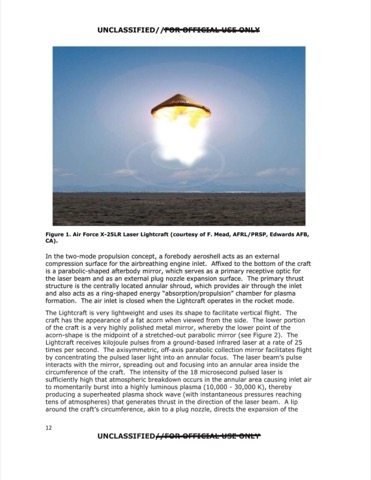
Image from page 16 of DOW-UAP-D143, as released by war.gov
Image from page 16 of the PDF. Open the scan to see the whole page.

Cite this page

U.S. Department of War. "AAWSAP DIRD, Laser Lightcraft Nanosatellites, November 2010" (DOW-UAP-D143). PURSUE Release 06, U.S. Department of War, September 18, 2026. https://www.war.gov/medialink/ufo/sept-18/release-06/assets/DOW-UAP-D143_AAWSAP-DIRD-Laser-Lightcraft-Nanosatellites-November-1-2010.pdf. Declassified UAP, page 16, https://declassifieduap.org/r/dow-uap-d143-aawsap-dird-laser-lightcraft-nanosatellites-november-2010/p/16. Accessed November 28, 2026.

This address shows page 16 on its own; /r/dow-uap-d143-aawsap-dird-laser-lightcraft-nanosatellites-november-2010?page=16 opens the same page in the full reader. Both stay. How to cite.