DOW-UAP-D142

AAWSAP DIRD, Concepts for Extracting Energy from the Quantum Vacuum, April 2010, page 17

One page of a U.S. government record released under PURSUE, shown on its own with its text. The record page has the whole document, its catalog details and the scan.

Page
17 of 57
Agency
Department of War
Released
Release 06, September 18, 2026

Text of page 17

UNCLASSIFIED//FOR O AL USE ONLY 20 - - 7' ENERGY Figure 5. Energy Released from Ground State Suppression of Hydrogenic Atom in a Microcavity. (rb = free-space Bohr orbit radius, r' = suppressed Bohr orbit radius, 2 = resonant wavelength of Bohr orbit, and Eout = released energy). Consider the possibility that the decay to a new sub-Bohr ground state would involve gradual release of energy in the form of heat, rather than a sudden optical radiation signature. Since the binding energy of the electron is 13.6 eV,® it is estimated that the amount of energy released in this process could be on the order of 1 to 10 eV for injection of the hydrogen atom into a Casimir cavity of d = 250 A. Furthermore, consider the possibility that when the electron exits the cavity it would reabsorb energy from the zero-point field and be re-excited to its normal state. If these conjectures were to be verified by experiment, then the energy extracted in the process comes at the expense of the zero-point field, which in the SED interpretation propagates at the speed of light throughout the universe. In effect the energy would be extracted locally and replenished globally. The secondary consequences on other phenomena, if this energy conversion were to succeed, have not yet been investigated. However, on a cautionary note, the conflicts between SED and QED theories (discussed in Section V) raise questions as to whether the conjectured approach discussed here is viable. This issue is perhaps best addressed by experiment for its resolution. In terms of an experimental test, consider using monatomic gases or liquids flowing in a block with Casimir tunnels, which has the following attributes: 1) no dissociation process is required for monatomic gases or liquids, 2) heavier element atoms are approximately two to four times larger than hydrogen and thus can utilize and be affected by a larger Casimir cavity, 3) heavier elements have numerous outer shell electrons, several of which may be simultaneously affected by the reduction of zero- point radiation in a Casimir cavity. All of the noble gas elements contain ns electrons. He (Z = 2, r = 1.2 A) has two 1s electrons. Ne (Z = 10, r = 1.3 A) has two each of 1s and 2s electrons. Ar (Z = 18, r = 1.6 Ä) has two each of 1s, 2s, and 3s electrons. Kr (Z = 36, r = 1.8 A) has two of each 8 1 eV = 1.602 × 10⁻¹⁹ J. 11 UNCLASSIFIED/ /EOR DEFICIAL USE ONLY

Machine-read (OCR) from the scan by this archive; it can contain errors. The scan is the record.
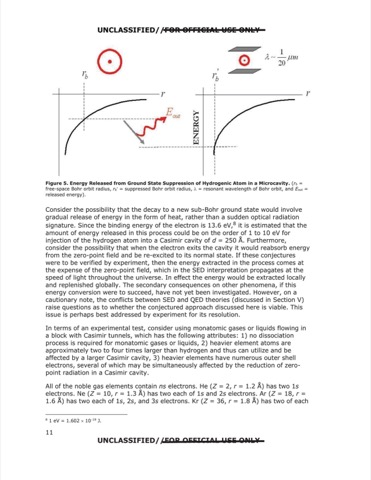
Image from page 17 of DOW-UAP-D142, as released by war.gov
Image from page 17 of the PDF. Open the scan to see the whole page.

Cite this page

U.S. Department of War. "AAWSAP DIRD, Concepts for Extracting Energy from the Quantum Vacuum, April 2010" (DOW-UAP-D142). PURSUE Release 06, U.S. Department of War, September 18, 2026. https://www.war.gov/medialink/ufo/sept-18/release-06/assets/DOW-UAP-D142_AAWSAP-DIRD-Concepts-for-Extracting-Energy-from-the-Quantum-Vacuum-April-6-2010.pdf. Declassified UAP, page 17, https://declassifieduap.org/r/dow-uap-d142-aawsap-dird-concepts-for-extracting-energy-from-the-quantum-vacuum-april-2010/p/17. Accessed November 28, 2026.

This address shows page 17 on its own; /r/dow-uap-d142-aawsap-dird-concepts-for-extracting-energy-from-the-quantum-vacuum-april-2010?page=17 opens the same page in the full reader. Both stay. How to cite.