Text of page 9
UNCLASSIFIED/FOR DEFT
AL USE ONLT
75-
Transverse
50 -
-25
fill
Ag
MgF:
-75
1-1 um-1
12
14
Wavelength (um)
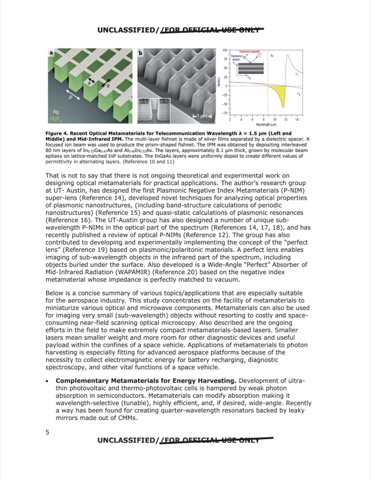
Figure 4. Recent Optical Metamaterials for Telecommunication Wavelength ^ = 1.5 pm (Left and
Middle) and Mid-Infrared IPM. The multi-layer fishnet is made of silver films separated by a dielectric spacer. A
focused ion beam was used to produce the prism-shaped fishnet. The IPM was obtained by depositing interleaved
80 mm layers of Ino.53Gao.47As and Alo.48Ino.52As. The layers, approximately 8.1 um thick, grown by molecular beam
epitaxy on lattice-matched InP substrates. The InGaAs layers were uniformly doped to create different values of
permittivity in alternating layers. (Reference 10 and 11)
That is not to say that there is not ongoing theoretical and experimental work on
designing optical metamaterials for practical applications. The author's research group
at UT- Austin, has designed the first Plasmonic Negative Index Metamaterials (P-NIM)
super-lens (Reference 14), developed novel techniques for analyzing optical properties
of plasmonic nanostructures, (including band-structure calculations of periodic
nanostructures) (Reference 15) and quasi-static calculations of plasmonic resonances
(Reference 16). The UT-Austin group has also designed a number of unique sub-
wavelength P-NIMs in the optical part of the spectrum (References 14, 17, 18), and has
recently published a review of optical P-NIMs (Reference 12). The group has also
contributed to developing and experimentally implementing the concept of the "perfect
lens" (Reference 19) based on plasmonic/polaritonic materials. A perfect lens enables
imaging of sub-wavelength objects in the infrared part of the spectrum, including
objects buried under the surface. Also developed is a Wide-Angle "Perfect" Absorber of
Mid-Infrared Radiation (WAPAMIR) (Reference 20) based on the negative index
metamaterial whose impedance is perfectly matched to vacuum.
Below is a concise summary of various topics/applications that are especially suitable
for the aerospace industry. This study concentrates on the facility of metamaterials to
miniaturize various optical and microwave components. Metamaterials can also be used
for imaging very small (sub-wavelength) objects without resorting to costly and space-
consuming near-field scanning optical microscopy. Also described are the ongoing
efforts in the field to make extremely compact metamaterials-based lasers. Smaller
lasers mean smaller weight and more room for other diagnostic devices and useful
payload within the confines of a space vehicle. Applications of metamaterials to photon
harvesting is especially fitting for advanced aerospace platforms because of the
necessity to collect electromagnetic energy for battery recharging, diagnostic
spectroscopy, and other vital functions of a space vehicle.
• Complementary Metamaterials for Energy Harvesting. Development of ultra-
thin photovoltaic and thermo-photovoltaic cells is hampered by weak photon
absorption in semiconductors. Metamaterials can modify absorption making it
wavelength-selective (tunable), highly efficient, and, if desired, wide-angle. Recently
a way has been found for creating quarter-wavelength resonators backed by leaky
mirrors made out of CMMs.
5
UNCLASSIFIED/LEOR OFFICIAL USE ONLY