DOW-UAP-D141

AAWSAP DIRD, Metamaterials for Aerospace Applications, April 2010, page 33

One page of a U.S. government record released under PURSUE, shown on its own with its text. The record page has the whole document, its catalog details and the scan.

Page
33 of 38
Agency
Department of War
Released
Release 06, September 18, 2026

Text of page 33

UNCLASSIFIED/ LEOR OFFICIAL USE ONLY 0.8 - = 0.6 - 0.4- 0.2 - 100 200 300 400 500 Fiber length [mm] Figure 25. Example of Time-Irreversibility of Light Propagation Inside the Twisted Fiber Core: the core mode propagates with almost no loss from left to right (purple solid line), reflects back, and gets dissipated/mode converted on its way back (red line). Input mode is assumed to be right-hand circularly polarized (RCP). Mode conversion: into LCP cladding mode (dashed line). Propagation from left to right is represented by the red lines, from right to left: by the purple lines. As an example, we have used a Chiral Fiber (CF) with the following properties: a 2 um x 1.8 um elliptical core with refractive index of n. =2.2 surrounded by a round cladding with radius R = 20 um and refractive index n, = 2.15. The helical pitch is assumed to linearly vary over max = 500 mm by 6 percent around A = 166 um. The assumed y corresponds to the nonlinear refractive index n2 = 5.4 × 10⁻¹⁶ m?/W at the operating vacuum wavelength 1 = 1.5 um and the peak power P = 3.5 W. The cladding mode was assumed to be lossy with the loss coefficient a = 10 dB/m . Results are shown in Figure 25. A core mode injected from the left end of the fiber (z = 0) propagates through the fiber without converting into the cladding mode (purple solid line) with minimal losses. After getting reflected at z = 500 mm, the principal core mode (red solid line) gets converted into the delocalized cladding mode (red dashed line) and damped out. This example clearly demonstrates that the interplay between mode-coupling, nonlinearity, and losses can result in the dramatic loss of time-reversal. Future research will be looking at other metamaterial systems that support two distinct modes (one with a strongly nonlinear response and strong spatial localization, the other essentially linear and delocalized), orthogonal polarizations, and investigate non- reciprocal wave propagation in such metamaterials. Structures from the previous 29 UNCLASSIFIED/ LEOR DEFICIAL USE ONL

Machine-read (OCR) from the scan by this archive; it can contain errors. The scan is the record.
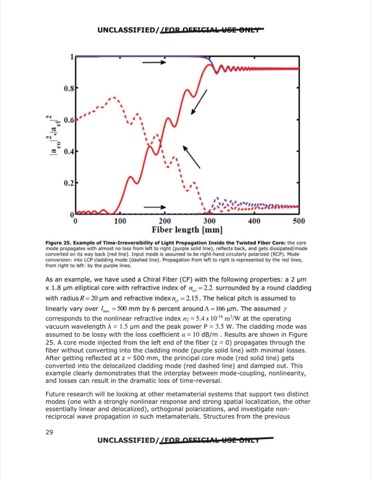
Image from page 33 of DOW-UAP-D141, as released by war.gov
Image from page 33 of the PDF. Open the scan to see the whole page.

Cite this page

U.S. Department of War. "AAWSAP DIRD, Metamaterials for Aerospace Applications, April 2010" (DOW-UAP-D141). PURSUE Release 06, U.S. Department of War, September 18, 2026. https://www.war.gov/medialink/ufo/sept-18/release-06/assets/DOW-UAP-D141_AAWSAP-DIRD-Metamaterials-for-Aerospace-Applications-April-6-2010.pdf. Declassified UAP, page 33, https://declassifieduap.org/r/dow-uap-d141-aawsap-dird-metamaterials-for-aerospace-applications-april-2010/p/33. Accessed November 28, 2026.

This address shows page 33 on its own; /r/dow-uap-d141-aawsap-dird-metamaterials-for-aerospace-applications-april-2010?page=33 opens the same page in the full reader. Both stay. How to cite.