DOW-UAP-D141

AAWSAP DIRD, Metamaterials for Aerospace Applications, April 2010, page 23

One page of a U.S. government record released under PURSUE, shown on its own with its text. The record page has the whole document, its catalog details and the scan.

Page
23 of 38
Agency
Department of War
Released
Release 06, September 18, 2026

Text of page 23

UNCLASSIFIED/ LEOR OFFICIAL USE ONET Because the exploited resonance has a quadrupole nature, it is slightly red-shifted. For that reason, the length of the "dark" antenna is 100 nm. When the two antennas are brought together, the radiative antenna polarizes the dark antenna, which, in turn, depolarizes the radiative antenna. As a result, the dipole moment of the coupled system is drastically reduced, the reflection drops and transmission increases to almost 100 percent (limited only by losses). Most of the energy is now stored inside the non- radiative (dark) antenna. If multiple layers of dark/bright antennas are employed as shown in Figure 16, then one can achieve one of the most important manifestations of EIT; "slow" light. Slow light can have many interesting technological applications because (a) slow light is easy to manipulate by changing the structure's parameters (as described in the section on tunable metamaterials), and (b) slow light has a high field intensity (enhanced by the ratio of the free-space propagation speed to the slow propagation speed), therefore, all nonlinear processes are enhanced for slow light. Such nonlinear processes may include harmonics generation, optical diode action (see the section on non-reciprocal optical elements), and many others. (a) H k /55777 Fietal strip Couple to a dye tenna (ter perpendi at mel Sars such mere material exhibits slow sinate propagation along the incidence direction (slowed down by a factor 30 or more). (Reference 32) It is important to realize that the geometry suggested in Reference 32 is not unique. For example, the dark and radiative antennas need not reside in the same plane. Nor is the effect of EIT (and the related phenomenon of slow light) limited to the optical domain. Both infrared and microwave-range designs have started emerging. These frequency domains are likely to be of greater use for advanced aerospace platforms than the visible range targeted by most studies. 19 UNCLASSIFIED/LEOR OFFICIAL USE ONLY

Machine-read (OCR) from the scan by this archive; it can contain errors. The scan is the record.
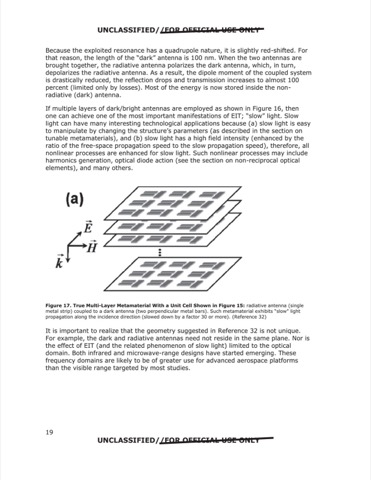
Image from page 23 of DOW-UAP-D141, as released by war.gov
Image from page 23 of the PDF. Open the scan to see the whole page.

Cite this page

U.S. Department of War. "AAWSAP DIRD, Metamaterials for Aerospace Applications, April 2010" (DOW-UAP-D141). PURSUE Release 06, U.S. Department of War, September 18, 2026. https://www.war.gov/medialink/ufo/sept-18/release-06/assets/DOW-UAP-D141_AAWSAP-DIRD-Metamaterials-for-Aerospace-Applications-April-6-2010.pdf. Declassified UAP, page 23, https://declassifieduap.org/r/dow-uap-d141-aawsap-dird-metamaterials-for-aerospace-applications-april-2010/p/23. Accessed November 28, 2026.

This address shows page 23 on its own; /r/dow-uap-d141-aawsap-dird-metamaterials-for-aerospace-applications-april-2010?page=23 opens the same page in the full reader. Both stay. How to cite.