DOW-UAP-D141

AAWSAP DIRD, Metamaterials for Aerospace Applications, April 2010, page 11

One page of a U.S. government record released under PURSUE, shown on its own with its text. The record page has the whole document, its catalog details and the scan.

Page
11 of 38
Agency
Department of War
Released
Release 06, September 18, 2026

Text of page 11

UNCLASSIFIED / LEOR DEFI LUSE ONLT 2 > d Figure 5. Schematic of the Super-Lens with n=-1 Refractive Index Corresponding to (e = -1, M = -1) Surrounded By Vacuum. Super-lens' presence enables imaging sub-diffraction objects such as the periodic grating shown here. There are, however, interesting circumstances when it is very important to transport the image towards the scanning device. One such special circumstance is spatially- resolved spectroscopy of small (for example, cellular) structures. One can envision space expeditions to other planets that could, potentially, result in finding some evidence of primitive cellular-level life. It would then be highly desirable to examine the structure of the living cell in its natural environment. In all likelihood, that environment would be liquid. Therefore, it would be very desirable to examine the cell without actually touching it with a tip of a near-field optical microscope. Thus, the sub-surface imaging of a small object which is buried underneath a liquid layer would be necessary. No such experiments have so far been conducted. However, several years ago there was an experiment demonstrating imaging of sub-diffraction objects buried under the layer of silicon dioxide. The schematic and experimental results from the experiment (Reference 19) are shown in Figure 6. In this experiment the sub-wavelength objects were simple holes that were milled in the metal using an FIB. They were buried underneath the super-lens consisting of SiC (negative epsilon material for mid-infrared frequencies) and silicon dioxide (positive epsilon material). Note that this configuration (materials with &, > 0 and 8, = -8, <0 joined together: sandwiched or positioned next to each other) is typical for a near-field super-lens. The difference between the near-field super-lens shown in Figure 6 and the "ideal" super-lens shown in Figure 5 is that the ideal also requires a material with a negative value of magnetic permeability. 7 UNCLASSIFIED/LEOR OFFICIAL USE ONLY

Machine-read (OCR) from the scan by this archive; it can contain errors. The scan is the record.
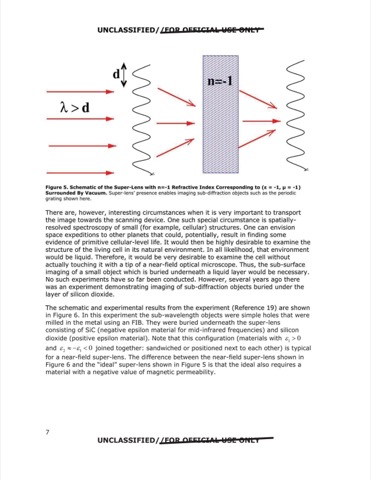
Image from page 11 of DOW-UAP-D141, as released by war.gov
Image from page 11 of the PDF. Open the scan to see the whole page.

Cite this page

U.S. Department of War. "AAWSAP DIRD, Metamaterials for Aerospace Applications, April 2010" (DOW-UAP-D141). PURSUE Release 06, U.S. Department of War, September 18, 2026. https://www.war.gov/medialink/ufo/sept-18/release-06/assets/DOW-UAP-D141_AAWSAP-DIRD-Metamaterials-for-Aerospace-Applications-April-6-2010.pdf. Declassified UAP, page 11, https://declassifieduap.org/r/dow-uap-d141-aawsap-dird-metamaterials-for-aerospace-applications-april-2010/p/11. Accessed November 28, 2026.

This address shows page 11 on its own; /r/dow-uap-d141-aawsap-dird-metamaterials-for-aerospace-applications-april-2010?page=11 opens the same page in the full reader. Both stay. How to cite.