DOW-UAP-D140

AAWSAP DIRD, High-Frequency Gravitational Wave Communications, April 2010, page 8

One page of a U.S. government record released under PURSUE, shown on its own with its text. The record page has the whole document, its catalog details and the scan.

Page
8 of 57
Agency
Department of War
Released
Release 06, September 18, 2026

Text of page 8

UNCLASSIFIED// FOR OFFICIAL USE ONLY- rotating rods, laboratory HFGW generation, and so forth is based upon the "jerk" or shake of mass (time rate of change of acceleration) and is derived by Baker (2006) as P = 1.76×10-52 (2rf/At)2 W (1) where is tore, over the time intervat he, sis tant is, the enor make or the tris a masses, such as the change in centrifugal force vector with time; for example, as masses move around each other on a circular orbit. Figure 2 describes that situation. Please recognize, however, that Af need NOT be a gravitational force (see Einstein, 1918; Infeld quoted by Weber 1964, p. 97; Grishchuk 1974). Electromagnetic forces are more than 1035 larger than gravitational forces and should be employed in laboratory GW generation. As Weber (1964, p. 97) points out: "The non-gravitational forces play a decisive role in methods for detection and generation of gravitational waves ..." Equation (1) is also termed "quadrupole formalism" and holds in weak gravitational fields (well over 100 g's), for speeds of the generator "components" less than the speed of light and for r less than the GW wavelength. This last restriction may not really apply. Certainly there would be GW generated for r greater than the GW wavelength, but the quadrupole formalism might not apply exactly. For very small At, the GW wavelength, 16w = cAt (where c ~ 3x10⁸ ms?, the speed of light) is very small and the GW frequency Vgw is high. As a numerical example, r is choosen to be 10 m (convenient laboratory size, though usually greater than Agw), Af = 4x10⁸ N; for example, the force produced by a large number of piezoelectric resonators and At = 2x10⁻¹⁰ s; equivalent to about a gw = 5 GHz jerk or shake frequency so that Agw = 6 cm and P = 2.8×10⁻¹³ W or 0.28 picowatts. Clearly a very small HFGW power is generated. GW GW A RADIATION PATTERN 'GW A't Afci 8 fef Afer fet B GENERATOR'S FOCUS Aft GW GW Fig to Achieve in Radiatial Force of Orbiting Masses, Afa, Replaced by Change in Tangential Force, One of the first suggested means for the laboratory generation of HFGWs was the so- called gaser analogous to the laser for light. Simply described (Halpern and Laurent, 3 UNCLASSIFIED/ /EOR OFFICIAL USE ONLT

Machine-read (OCR) from the scan by this archive; it can contain errors. The scan is the record.
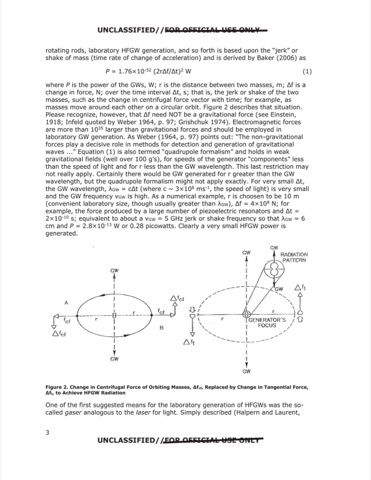
Image from page 8 of DOW-UAP-D140, as released by war.gov
Image from page 8 of the PDF. Open the scan to see the whole page.

Cite this page

U.S. Department of War. "AAWSAP DIRD, High-Frequency Gravitational Wave Communications, April 2010" (DOW-UAP-D140). PURSUE Release 06, U.S. Department of War, September 18, 2026. https://www.war.gov/medialink/ufo/sept-18/release-06/assets/DOW-UAP-D140_AAWSAP-DIRD-High-Frequency-Gravitational-Wave-Communications-April-6-2010.pdf. Declassified UAP, page 8, https://declassifieduap.org/r/dow-uap-d140-aawsap-dird-high-frequency-gravitational-wave-communications-april-2010/p/8. Accessed November 28, 2026.

This address shows page 8 on its own; /r/dow-uap-d140-aawsap-dird-high-frequency-gravitational-wave-communications-april-2010?page=8 opens the same page in the full reader. Both stay. How to cite.