Text of page 28
UNCLASSIFIED// FOR OFFICIAL USE ONLY
Signal to noise ratios (SNR's) at the transmitter and at the receiver
must be calculated to support a communications link design.
Predicted SNR
Components at
the Transmitter
Link
Loss
Predicted SNR
Components at
the Receiver
GW
Source
Noise
GW
Xmit
Signal
1/R2
Loss
GW
Signal
Rev'ed
GW Antenna
& Receiver
Noise
Signal
Noise
EM to GW
Conversion
Noise
EM Source
Noise
EM Receiver
Noise
GW to EM
Conversion
Noise
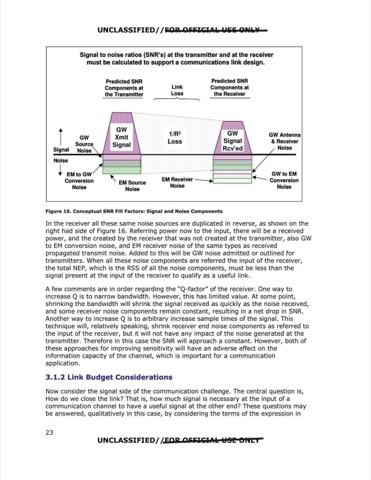
Figure 16. Conceptual SNR Fill Factors: Signal and Noise Components
In the receiver all these same noise sources are duplicated in reverse, as shown on the
right had side of Figure 16. Referring power now to the input, there will be a received
power, and the created by the receiver that was not created at the transmitter, also GW
to EM conversion noise, and EM receiver noise of the same types as received
propagated transmit noise. Added to this will be GW noise admitted or outlined for
transmitters. When all these noise components are referred the input of the receiver,
the total NEP, which is the RSS of all the noise components, must be less than the
signal present at the input of the receiver to qualify as a useful link.
A few comments are in order regarding the "Q-factor" of the receiver. One way to
increase Q is to narrow bandwidth. However, this has limited value. At some point,
shrinking the bandwidth will shrink the signal received as quickly as the noise received,
and some receiver noise components remain constant, resulting in a net drop in SNR.
Another way to increase Q is to arbitrary increase sample times of the signal. This
technique will, relatively speaking, shrink receiver end noise components as referred to
the input of the receiver, but it will not have any impact of the noise generated at the
transmitter. Therefore in this case the SNR will approach a constant. However, both of
these approaches for improving sensitivity will have an adverse effect on the
information capacity of the channel, which is important for a communication
application.
3.1.2 Link Budget Considerations
Now consider the signal side of the communication challenge. The central question is,
How do we close the link? That is, how much signal is necessary at the input of a
communication channel to have a useful signal at the other end? These questions may
be answered, qualitatively in this case, by considering the terms of the expression in
23
UNCLASSIFIED/ /EOR OFFICIAL USE ONLY