Text of page 23
UNCLASSIFIED// FOR OFFICIAL USE ONLY
Coherent Versus Stochastic SQL
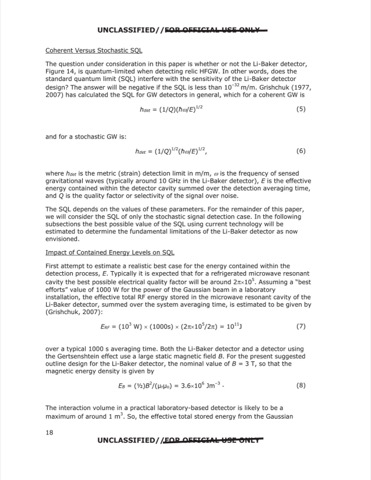
The question under consideration in this paper is whether or not the Li-Baker detector,
Figure 14, is quantum-limited when detecting relic HFGW. In other words, does the
standard quantum limit (SQL) interfere with the sensitivity of the Li-Baker detector
design? The answer will be negative if the SQL is less than 10-32 m/m. Grishchuk (1977,
2007) has calculated the SQL for GW detectors in general, which for a coherent GW is
hdet = (1/Q)(ho/E) /2
(5)
and for a stochastic GW is:
hdet = (1/Q) 2(ho/E) /2,
(6)
where hdet is the metric (strain) detection limit in m/m, a is the frequency of sensed
gravitational waves (typically around 10 GHz in the Li-Baker detector), E is the effective
energy contained within the detector cavity summed over the detection averaging time,
and Q is the quality factor or selectivity of the signal over noise.
The SQL depends on the values of these parameters. For the remainder of this paper,
we will consider the SQL of only the stochastic signal detection case. In the following
subsections the best possible value of the SQL using current technology will be
estimated to determine the fundamental limitations of the Li-Baker detector as now
envisioned.
Impact of Contained Energy Levels on SQL
First attempt to estimate a realistic best case for the energy contained within the
detection process, E. Typically it is expected that for a refrigerated microwave resonant
cavity the best possible electrical quality factor will be around 2x10⁵
'. Assuming a "best
efforts" value of 1000 W for the power of the Gaussian beam in a laboratory
installation, the effective total RF energy stored in the microwave resonant cavity of the
Li-Baker detector, summed over the system averaging time, is estimated to be given by
(Grishchuk, 2007):
ERF = (103 W) × (1000s) × (2x10⁵/2) = 101J
(7)
over a typical 1000 s averaging time. Both the Li-Baker detector and a detector using
the Gertsenshtein effect use a large static magnetic field B. For the present suggested
outline design for the Li-Baker detector, the nominal value of B = 3 T, so that the
magnetic energy density is given by
EB = (½)B₴/(MrHo) = 3.6×10° Jm 3 .
(8)
The interaction volume in a practical laboratory-based detector is likely to be a
maximum of around 1 m'. So, the effective total stored energy from the Gaussian
18
UNCLASSIFIED/ /EOR OFFICIAL USE ONLT