DOW-UAP-D140

AAWSAP DIRD, High-Frequency Gravitational Wave Communications, April 2010, page 19

One page of a U.S. government record released under PURSUE, shown on its own with its text. The record page has the whole document, its catalog details and the scan.

Page
19 of 57
Agency
Department of War
Released
Release 06, September 18, 2026

Text of page 19

UNCLASSIFIED// FOR OFFICIAL USE ONLY- According to Cruise (2008) of Birmingham University its frequency is limited to 100 MHz and at higher frequencies its sensitivity diminishes. In the case of the Infrared-excited molecules approach, on might employ a variant of the Robinson Gravitational Wave Bacontric rele angular the mir Miceate Backgrout M polarimeter, but might possibly be modifiable for direct HFGW detection. UNIVERSITYOF BIRMINGHAM Development of 100MHz GW detectors at National Astronomical Observatory of Japan • Arm length: 75 cm • Aimed GW frequency: 100 MHz • Finesse: 100 Laser BS • Recycling mirror 1 Two synchronous recycling interferometers were built! Photo detector Synchronous recycling Interferometer (Concept: Drever 1983) Figure 11. The National Astronomical Observatory of Japan 100 MHz Detector 2.2.2 Concept (Li-Effect) The Li-Effect was first published in 1992 and subsequently, some nine peer-reviewed papers have been published concerning it including a capstone paper, Li, et al. (2008) included as Appendix C. The Li-Effect is very different from the classical (inverse) Gertsenshtein-Effect. With the Li-Effect, a gravitational wave transfers energy to a separately generated electromagnetic (EM) wave in the presence of a static magnetic field. That EM wave has the same frequency as the GW and moves in the same direction. This is the "synchro-resonance condition," in which the EM and GW waves are synchronized (move in the same direction and have the same frequency) and is unlike the Gertsenshtein- Effect. The result of the intersection of the parallel and superimposed EM and GW beams, according to the Li-Effect, is new EM photons moving off in a direction perpendicular to the beams and the magnetic field directions. Thus, these new photons occupy a separate region of space (see Figure 12) that can be made essentially noise-free and the synchro-resonance EM beam itself (in this case a Gaussian beam) is not sensed there, so it does not interfere with detection of the photons. This Li-Effect was utilized by Baker (2001) in the design of the Li-Baker HFGW detector and Chinese Patent (Baker, 2000) of a device to detect HFGWs, the innovative Li-Baker HFGW Detector. 14 UNCLASSIFIED/ /EOR OFFICIAL USE ONLT

Machine-read (OCR) from the scan by this archive; it can contain errors. The scan is the record.
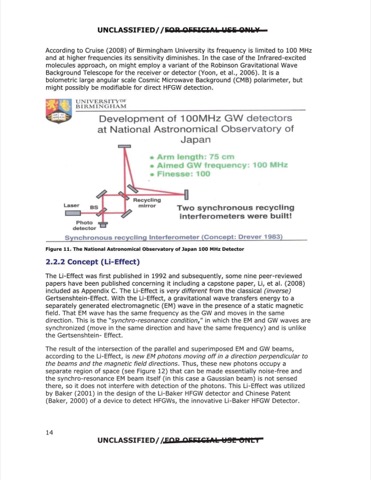
Image from page 19 of DOW-UAP-D140, as released by war.gov
Image from page 19 of the PDF. Open the scan to see the whole page.

Cite this page

U.S. Department of War. "AAWSAP DIRD, High-Frequency Gravitational Wave Communications, April 2010" (DOW-UAP-D140). PURSUE Release 06, U.S. Department of War, September 18, 2026. https://www.war.gov/medialink/ufo/sept-18/release-06/assets/DOW-UAP-D140_AAWSAP-DIRD-High-Frequency-Gravitational-Wave-Communications-April-6-2010.pdf. Declassified UAP, page 19, https://declassifieduap.org/r/dow-uap-d140-aawsap-dird-high-frequency-gravitational-wave-communications-april-2010/p/19. Accessed November 28, 2026.

This address shows page 19 on its own; /r/dow-uap-d140-aawsap-dird-high-frequency-gravitational-wave-communications-april-2010?page=19 opens the same page in the full reader. Both stay. How to cite.