DOW-UAP-D140

AAWSAP DIRD, High-Frequency Gravitational Wave Communications, April 2010, page 15

One page of a U.S. government record released under PURSUE, shown on its own with its text. The record page has the whole document, its catalog details and the scan.

Page
15 of 57
Agency
Department of War
Released
Release 06, September 18, 2026

Text of page 15

UNCLASSIFIED// FOR OFFE AL USE ONLY GWs GW(x) -- Unit (m?) Area Sphere GWs Figure 7. Omni-Directional Nature of the HFGW Radiation Pattern Next consider a more convenient laboratory arrangement for the rings. The ring radius is reduced to one meter, but set up 100 rings, concentrically (side by side concentric rings in the same plane or plate) with an average radius of the one meter. The reduced radius drops the Pi by (100)2 to 4.62x10⁻²⁰, but because of the 100 concentric rings the n = 4.85×10¹⁷/2 remains the same. Thus the flux for a single "plate" of concentric rings is only reduced by 104 to 1.29x10⁻⁴ Wm-2. Now stack some 106 of these 1.25×10⁻⁶ m thick plates on top of one another. Thus a 1.25 m high stack, barrel or cylinder as described in Baker (2001) is created. In this case, as shown in Figure 6, N = 106 and the N? law can be applied. Thus a HFGW total flux of 1.29×10⁸ Wm 2 in a very narrow beam will be generated by the stack. Of course (as pointed out in Woods and Baker (2009)) caution needs to be taken on how much power is fed to each ring. One possible arrangement is to feed the output of one ring to the input of the next. The problem here is that the source won't have a long enough coherence length, even if the attenuation of the IR doesn't kill the power after a ring or two. To avoid this, from one source the available energizing power could be divided equally between all the rings and fed to them up the stack or cylinder at the speed of light. The practical difficulties would be how to drive them all in correct phase, but it is a challenge for future research in the IR-ring approach. For an operational 50,000 infrared (IR), 12.5 meter long, 10-meter radius (104 concentric rings per plate so Pi = 1.29×10² Wm-2 and 107 plates) cylindrical HFGW generator (Woods and Baker, 2009), the flux at a one-meter distance from the * 11.20 13) 1-45x10 am very large, but wer 2 Very narrow 2.3 11 16x1012) half-power-point needle beam). The required generator power can be reduced by utilizing pulsed HFGWs. Suppose that the distance between the generating or transmitting device and the detecting or receiving device is a little more than an Earth's equatorial radius, or ~ 7x10⁶ meters. At this distance, 7,000 km, the flux of the 10 UNCLASSIFIED/ /EOR OFFICIAL USE ONLT

Machine-read (OCR) from the scan by this archive; it can contain errors. The scan is the record.
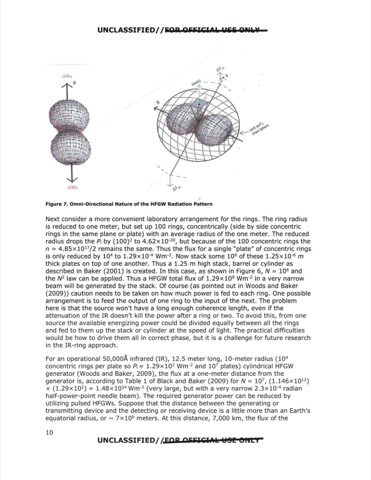
Image from page 15 of DOW-UAP-D140, as released by war.gov
Image from page 15 of the PDF. Open the scan to see the whole page.

Cite this page

U.S. Department of War. "AAWSAP DIRD, High-Frequency Gravitational Wave Communications, April 2010" (DOW-UAP-D140). PURSUE Release 06, U.S. Department of War, September 18, 2026. https://www.war.gov/medialink/ufo/sept-18/release-06/assets/DOW-UAP-D140_AAWSAP-DIRD-High-Frequency-Gravitational-Wave-Communications-April-6-2010.pdf. Declassified UAP, page 15, https://declassifieduap.org/r/dow-uap-d140-aawsap-dird-high-frequency-gravitational-wave-communications-april-2010/p/15. Accessed November 28, 2026.

This address shows page 15 on its own; /r/dow-uap-d140-aawsap-dird-high-frequency-gravitational-wave-communications-april-2010?page=15 opens the same page in the full reader. Both stay. How to cite.