DOW-UAP-D137

AAWSAP DIRD, State of the Art and Evolution of High-Energy Lasers, March 2010, page 7

One page of a U.S. government record released under PURSUE, shown on its own with its text. The record page has the whole document, its catalog details and the scan.

Page
7 of 31
Agency
Department of War
Released
Release 06, September 18, 2026

Text of page 7

UNCLASSIFIED/FOR OFFICIAL USE ONLY HEL and Kinetic Weapons offer complementary capabilities Target Types Soft/Small/Fast E/O sensors (Dazzle or Destroy) Target tagging Fire starting Small UAVs Manpads Moving/tactical Vehicles Cell towers & comm nodes Radar antennas Power grids Ceramic RF radomes Military UAVs Individual persons Rockets, artillery & mortars ---- Missiles & Satellites ICBMs IRBMs TheaterBMs Cruise missiles Satellites Hardened or Large Area Tanks Armored vehicles Bridges Buildings Groups of people Increasing Laser Power or Increasing Range for Same Effect Laser Power Laser 1 kW Weapon Effectiveness --- KE Weapon Effectiveness 10 kW Easy Medium 1 MW Difficult Impractical Impractical Medium if stationary if isolated Difficult Easy if stationary if isolated Figure 1. Utility of KE and HEL Weapons ELEMENTS OF AN HEL WEAPON The purpose of an HEL weapon system is to place and maintain the focused laser beam on a target aim point for sufficient time to cause the desired heating effect. To accomplish this, the weapon beam is generated by the laser device, then shaped and relayed to the input of a pointing telescope (Figure 2). Laser beam sensors and steering mirrors are required to maintain the HEL beam centered as it traverses the optical train. The pointing telescope, which typically sits on azimuth and elevation gimbals, then expands the beam to the diameter of its primary mirror and focuses it to the range of the target while an imaging system (which can use a separate telescope or share the transmitting telescope) acquires the target, tracks it, and points the transmitting telescope's beam at the desired aim point. If the HEL beam's propagation path from the weapon to the target includes the earth's atmosphere, it can have a significant deleterious effect. Absorption and scattering of the beam, which reduce its strength at the target, are caused by molecular constituents of the atmosphere and aerosols such as haze or dust. Additionally, atmospheric turbulence spreads the focused spot and further reduces its effectiveness. All of these factors must be taken into account when designing a laser weapon. 2 UNCLASSIFIED/ /FOR OFFICIAL USE ONLY

Machine-read (OCR) from the scan by this archive; it can contain errors. The scan is the record.
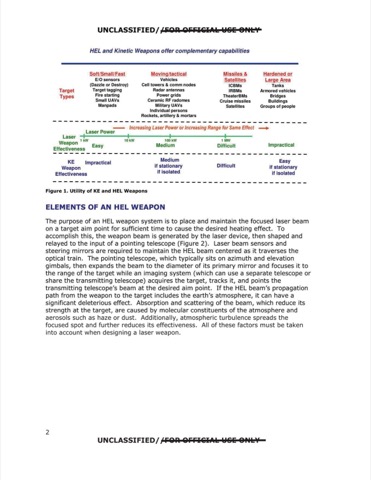
Image from page 7 of DOW-UAP-D137, as released by war.gov
Image from page 7 of the PDF. Open the scan to see the whole page.

Cite this page

U.S. Department of War. "AAWSAP DIRD, State of the Art and Evolution of High-Energy Lasers, March 2010" (DOW-UAP-D137). PURSUE Release 06, U.S. Department of War, September 18, 2026. https://www.war.gov/medialink/ufo/sept-18/release-06/assets/DOW-UAP-D137_AAWSAP-DIRD-State-of-the-Art-and-Evolution-of-High-Energy-Lasers-March-31-2010.pdf. Declassified UAP, page 7, https://declassifieduap.org/r/dow-uap-d137-aawsap-dird-state-of-the-art-and-evolution-of-high-energy-lasers-march-2010/p/7. Accessed November 28, 2026.

This address shows page 7 on its own; /r/dow-uap-d137-aawsap-dird-state-of-the-art-and-evolution-of-high-energy-lasers-march-2010?page=7 opens the same page in the full reader. Both stay. How to cite.