DOW-UAP-D137

AAWSAP DIRD, State of the Art and Evolution of High-Energy Lasers, March 2010, page 27

One page of a U.S. government record released under PURSUE, shown on its own with its text. The record page has the whole document, its catalog details and the scan.

Page
27 of 31
Agency
Department of War
Released
Release 06, September 18, 2026

Text of page 27

UNCLASSIFIED//FOR OFI ICIAL USE ONLY 10% A Visible • Near I R 500 - 700 nm 1.05 um to 1.15 um 1.2 um to 1.4 um Corneal Exposure (Joules/cm?) 10° 103 -6 10 475 nm 400 - 450 nm • 1 1 400 - 700 nm -15 10 •12 10 -9 10 -6 10 Time (seconds) Figure 18. Single Pulse Maximum Permissible Exposure -3 10 10 3 10 Vulnerability of Spacecraft to Laser Radiation Man-made objects in space, whether in earth-orbit or beyond and manned or unmanned, have attributes which lead to unique laser radiation vulnerabilities: • Whole-body vulnerability - Spacecraft operate in a delicate thermal equilibrium which requires maintenance of an overall, long-term temperature fairly close to 70 oF for the survival of electronics and personnel. They are heated by absorbed solar radiation, onboard electronics, mechanical and propulsion systems, internal heating systems, internal cooling systems, and any personnel on-board. Because of the surrounding vacuum, black-body radiation and material ejection are the only available methods of removing heat. If laser radiation were to permanently alter the solar absorption or black-body emission characteristics (referred to as the a/s ratio) of a significant portion of the spacecraft's external surface, this thermal balance could be destroyed with slow, but catastrophic results. This damage could conceivably be inflicted rapidly from a large earth-based laser weapon, if the spacecraft were in earth orbit, or inflicted more slowly by a smaller laser weapon which was onboard a much closer spacecraft. • Alternately, if a large earth-based laser system were to flood-load a spacecraft with a total power of megawatts for a few minutes (the typical duration of a low-earth orbit pass over a fixed location on earth), the spacecraft could potentially be heated to the point of failure. 22 UNCLASSIFIED/ /FOR OFFICIAL USE ONLY

Machine-read (OCR) from the scan by this archive; it can contain errors. The scan is the record.
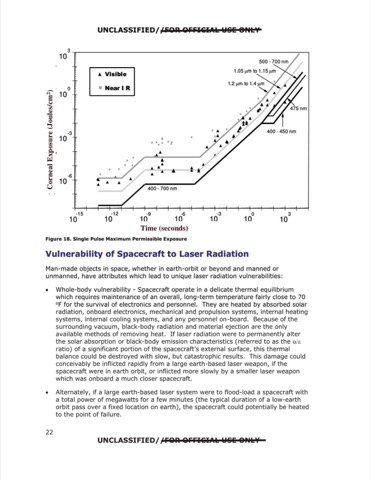
Image from page 27 of DOW-UAP-D137, as released by war.gov
Image from page 27 of the PDF. Open the scan to see the whole page.

Cite this page

U.S. Department of War. "AAWSAP DIRD, State of the Art and Evolution of High-Energy Lasers, March 2010" (DOW-UAP-D137). PURSUE Release 06, U.S. Department of War, September 18, 2026. https://www.war.gov/medialink/ufo/sept-18/release-06/assets/DOW-UAP-D137_AAWSAP-DIRD-State-of-the-Art-and-Evolution-of-High-Energy-Lasers-March-31-2010.pdf. Declassified UAP, page 27, https://declassifieduap.org/r/dow-uap-d137-aawsap-dird-state-of-the-art-and-evolution-of-high-energy-lasers-march-2010/p/27. Accessed November 28, 2026.

This address shows page 27 on its own; /r/dow-uap-d137-aawsap-dird-state-of-the-art-and-evolution-of-high-energy-lasers-march-2010?page=27 opens the same page in the full reader. Both stay. How to cite.