DOW-UAP-D137

AAWSAP DIRD, State of the Art and Evolution of High-Energy Lasers, March 2010, page 25

One page of a U.S. government record released under PURSUE, shown on its own with its text. The record page has the whole document, its catalog details and the scan.

Page
25 of 31
Agency
Department of War
Released
Release 06, September 18, 2026

Text of page 25

UNCLASSIFIED//FOR OFF AL USE ONLY ET Figure 17. The Advanced Tactical Laser C-130 Aircraft Laser-Material Interaction Laser radiation, with the exception of ultra-short pulse, damages materials by rapidly depositing heat on the target's surface. The field of laser effects/lethality studies this interaction at levels ranging from basic energy transfer physics to how specific military targets (such as missiles or mortar shells) could be defeated. The interaction of a laser beam with typical target materials such as metal, ceramic or fiberglass can vary significantly with parameters such as laser wavelength, irradiance level, material surface preparation and airflow. A material's hardness to laser radiation is frequently described using the parameter "W" in units of joules/cm3. This is a measure of the total energy (in joules) required to melt or remove one cubic cm of material under the specific conditions of the test. Over the past three decades, a wide variety of materials have been tested using a COz, DF and (more recently) Nd:YAG lasers. Although specific results are usually classified, general observations can be offered about typical material classes used in aircraft and spacecraft. A wide variety of metals are used for applications such as missile skins, pressurized fuel tanks, electronics enclosures, and structural members. Laser coupling can vary quite widely, from a few percent to almost 100 percent, depending on the laser wavelength, type of metal, surface preparation, and temperature. If not under structural load, failure is usually from complete melt-through. If the metal piece is under aerodynamic load or is part of a pressure vessel, failure will typically occur from crack initiation and propagation well before complete burn-through. Airflow is beneficial, providing melt removal and aerodynamic loads. The total energy which would cause a metal plate or pressure vessel to fail is thickness dependent in a fairly linear fashion. 20 UNCLASSIFIED/ /FOR OFFICIAL USE ONLY

Machine-read (OCR) from the scan by this archive; it can contain errors. The scan is the record.
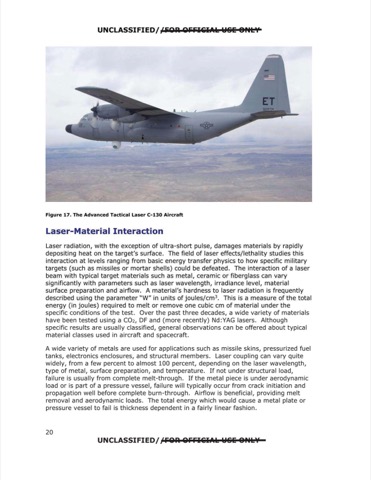
Image from page 25 of DOW-UAP-D137, as released by war.gov
Image from page 25 of the PDF. Open the scan to see the whole page.

Cite this page

U.S. Department of War. "AAWSAP DIRD, State of the Art and Evolution of High-Energy Lasers, March 2010" (DOW-UAP-D137). PURSUE Release 06, U.S. Department of War, September 18, 2026. https://www.war.gov/medialink/ufo/sept-18/release-06/assets/DOW-UAP-D137_AAWSAP-DIRD-State-of-the-Art-and-Evolution-of-High-Energy-Lasers-March-31-2010.pdf. Declassified UAP, page 25, https://declassifieduap.org/r/dow-uap-d137-aawsap-dird-state-of-the-art-and-evolution-of-high-energy-lasers-march-2010/p/25. Accessed November 28, 2026.

This address shows page 25 on its own; /r/dow-uap-d137-aawsap-dird-state-of-the-art-and-evolution-of-high-energy-lasers-march-2010?page=25 opens the same page in the full reader. Both stay. How to cite.