DOW-UAP-D136

AAWSAP DIRD, Biosensors and BioMEMS: A Survey of the Present Field, March 2010, page 8

One page of a U.S. government record released under PURSUE, shown on its own with its text. The record page has the whole document, its catalog details and the scan.

Page
8 of 45
Agency
Department of War
Released
Release 06, September 18, 2026

Text of page 8

UNCLASSIFIED//TOR USE ONLY Varieties of BioMEMs and Sensors ASU RE A B G301F SEM of gear assembly rota near motien dia Labs, Figure 1. Varieties of BioMEMS and Sensors. These BioMEMS devices were made at Arizona State University (ASU). They represent many of the areas of BioMEMS research. CHARACTERISTICS OF BIOMEMS Conceiving and designing BioMEMS devices requires a different perspective of the physical world. These devices can operate on principles such as capillary force, van der Waals forces, and electric-field forces. These forces become relatively strong when the size scale reaches very small dimensions. In the realm of the very small, the force of gravity is far less important than electrical charge and viscosity. From the perspective of microscale devices, engineers need to think about accomplishing tasks on an extremely subtle scale but with an exceptionally effective result. BioMEMS employs engineering sciences in ways that are more than just scaling down familiar devices used in biomedical applications. Rather, employment of new structures and new materials including polymers and biological components is necessary. In addition we need to be concerned about things like biocompatibility (the effect of the device on body tissue) as well as the degradation effects of tissues and body fluids on the device itself. Development of a new product that is targeted for implantation into the human body is particularly expensive due to federal regulation of medical devices. Devices must be shown to be effective for their intended use, and above all devices must be proved safe. Bringing a new device to market is not unlike the development of a new drug. In order 2 UNCLASSIFIED / LEOR OFFICIAL USE ONLY

Machine-read (OCR) from the scan by this archive; it can contain errors. The scan is the record.
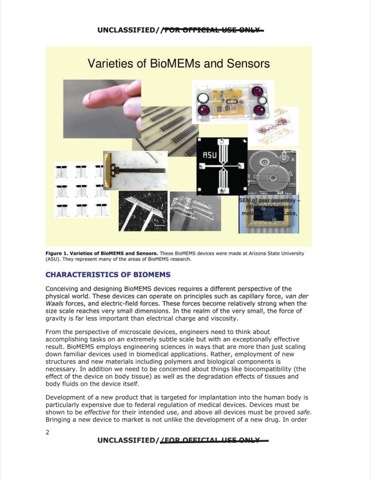
Image from page 8 of DOW-UAP-D136, as released by war.gov
Image from page 8 of the PDF. Open the scan to see the whole page.

Cite this page

U.S. Department of War. "AAWSAP DIRD, Biosensors and BioMEMS: A Survey of the Present Field, March 2010" (DOW-UAP-D136). PURSUE Release 06, U.S. Department of War, September 18, 2026. https://www.war.gov/medialink/ufo/sept-18/release-06/assets/DOW-UAP-D136_AAWSAP-DIRD-Biosensors-and-BioMEMS-A-Survey-of-the-Present-Field-March-31-2010.pdf. Declassified UAP, page 8, https://declassifieduap.org/r/dow-uap-d136-aawsap-dird-biosensors-and-biomems-a-survey-of-the-present-field-march-2010/p/8. Accessed November 28, 2026.

This address shows page 8 on its own; /r/dow-uap-d136-aawsap-dird-biosensors-and-biomems-a-survey-of-the-present-field-march-2010?page=8 opens the same page in the full reader. Both stay. How to cite.