DOW-UAP-D136

AAWSAP DIRD, Biosensors and BioMEMS: A Survey of the Present Field, March 2010, page 40

One page of a U.S. government record released under PURSUE, shown on its own with its text. The record page has the whole document, its catalog details and the scan.

Page
40 of 45
Agency
Department of War
Released
Release 06, September 18, 2026

Text of page 40

UNCLASSIFIED//TOR 01 AL USE ONLY twitte. Hosener www.nanogen.com Affymetrix www.affymetrix.com NanoChip The NanoChip(R) 400 cartridge ... constructs the user defined panel of genetic markers on one chip Caliper Technologies www.calipertech.com Aclara Biosciences Figure 31. Commercial Lab-Chip Devices That Allow Analysis for Biomarkers of Various Diseases Using on-Chip Electrophoresis in Microscale (collage from manufacturers listed) These MEMS devices incorporate micro-scale fluidic components, sensors, actuators, and customized surfaces created by chemical modification or coating with inorganic and organic materials; enabling tissue engineering and cell patterning studies along with the microfluidic control of the culture environment. NASA SPACE APPLICATIONS FOR MICROFLUIDIC SYSTEMS NASA has supported at Arizona State University, the development of new types of microfluidic systems directed towards growing cell cultures on a chip. The specific application is detecting the effects of space flight and microgravity on living things at the cellular scale. Space presents a number of stresses on the cells of the astronaut's body from electromagnetic fields, microgravity, and space cabin environments, which in combination have effects that are likely different than any single stress. Beyond affecting the astronaut directly, space flight can change any organism, and actually makes some bacteria more dangerous. Cells can be grown to represent the cells of the astronaut's body. Changes in DNA expression or molecular stress markers in cultured cells can be used to infer effects of space. Culturing mammalian cells in the laboratory generally requires constant attendance and adjustment, but astronauts have little time for routine culture procedures. Thus NASA supported the design of an automated microfluidic system to perform all the steps 34 UNCLASSIFIED/ LEOR OFFICIAL USE ONLY

Machine-read (OCR) from the scan by this archive; it can contain errors. The scan is the record.
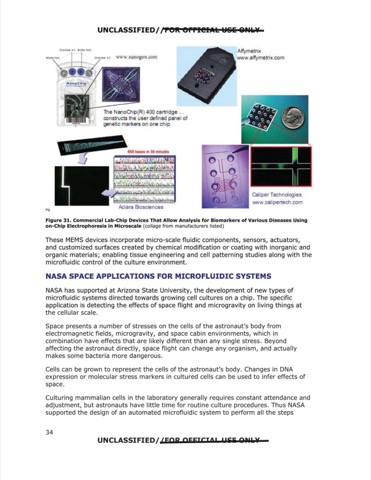
Image from page 40 of DOW-UAP-D136, as released by war.gov
Image from page 40 of the PDF. Open the scan to see the whole page.

Cite this page

U.S. Department of War. "AAWSAP DIRD, Biosensors and BioMEMS: A Survey of the Present Field, March 2010" (DOW-UAP-D136). PURSUE Release 06, U.S. Department of War, September 18, 2026. https://www.war.gov/medialink/ufo/sept-18/release-06/assets/DOW-UAP-D136_AAWSAP-DIRD-Biosensors-and-BioMEMS-A-Survey-of-the-Present-Field-March-31-2010.pdf. Declassified UAP, page 40, https://declassifieduap.org/r/dow-uap-d136-aawsap-dird-biosensors-and-biomems-a-survey-of-the-present-field-march-2010/p/40. Accessed November 28, 2026.

This address shows page 40 on its own; /r/dow-uap-d136-aawsap-dird-biosensors-and-biomems-a-survey-of-the-present-field-march-2010?page=40 opens the same page in the full reader. Both stay. How to cite.