DOW-UAP-D136

AAWSAP DIRD, Biosensors and BioMEMS: A Survey of the Present Field, March 2010, page 38

One page of a U.S. government record released under PURSUE, shown on its own with its text. The record page has the whole document, its catalog details and the scan.

Page
38 of 45
Agency
Department of War
Released
Release 06, September 18, 2026

Text of page 38

UNCLASSIFIED//FOR OFFIE AL USE ONLY Silver chloride electrodes (0.8 mm) encapsulation Diode (0.9mm) piezoelectric polymer (variable length 1-5 mm) Figure 29. Illustration of the Internal Construction of the Ultrasound Powered Neurostimulator Developed at ASU. Platinum ball electrodes at either end are the contacts to the tissue. (Towe et al.) This device has been implanted in rats and shown effective in neurostimulation under a wide variety of conditions. It appears suited to near-surface neurostimulations for relief of pain, and in the potential treatment of a variety of nervous system disorders. MEMS in Microfluidics Another major area of application of BioMEMS is the control of fluids on very small scales and quantities. This capability is important in rapidly testing blood chemistry from single drops of whole blood, in the laboratory for clinical chemistry, and in working with very small amounts of DNA derived from cellular extracts. Manufacturing small channels that conduct fluids is relatively straight forward using photolithography. A computer generated optical mask is used to expose patterns onto photoresists, then a process of etching by plasma or chemicals is used to carve out parts of the substrate. Substrates are often glass since it is cheap, easily formed, and is a reasonably inert and biocompatible surface. Figure 30 shows some of these kinds of configurations. Glass is easily etched by hydrofluoric acid, but also forms of sandblasting with a fine grit have recently been developed to cut holes in glass. Finely carved capillaries in glass can allow nanoliters or even picoliters of fluid to Figure 30. Microfluidics in Glass. Microfluidics in glass take advantage of MEMS to produce microscale devices that can do complex chemical analysis. (http://www.i-micronews.com/interviews/Micronit- Microfluidics-discusses-product-diversification.html) 32 UNCLASSIFIED/ LEOR OFE AL USE ONLY

Machine-read (OCR) from the scan by this archive; it can contain errors. The scan is the record.
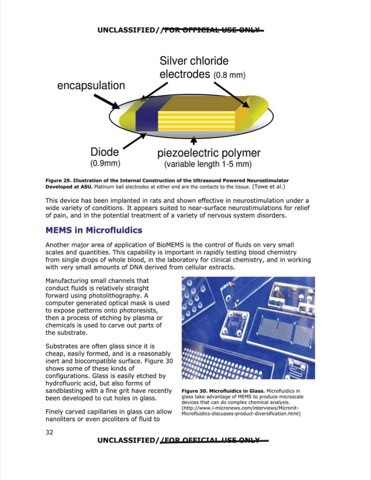
Image from page 38 of DOW-UAP-D136, as released by war.gov
Image from page 38 of the PDF. Open the scan to see the whole page.

Cite this page

U.S. Department of War. "AAWSAP DIRD, Biosensors and BioMEMS: A Survey of the Present Field, March 2010" (DOW-UAP-D136). PURSUE Release 06, U.S. Department of War, September 18, 2026. https://www.war.gov/medialink/ufo/sept-18/release-06/assets/DOW-UAP-D136_AAWSAP-DIRD-Biosensors-and-BioMEMS-A-Survey-of-the-Present-Field-March-31-2010.pdf. Declassified UAP, page 38, https://declassifieduap.org/r/dow-uap-d136-aawsap-dird-biosensors-and-biomems-a-survey-of-the-present-field-march-2010/p/38. Accessed November 28, 2026.

This address shows page 38 on its own; /r/dow-uap-d136-aawsap-dird-biosensors-and-biomems-a-survey-of-the-present-field-march-2010?page=38 opens the same page in the full reader. Both stay. How to cite.