DOW-UAP-D136

AAWSAP DIRD, Biosensors and BioMEMS: A Survey of the Present Field, March 2010, page 31

One page of a U.S. government record released under PURSUE, shown on its own with its text. The record page has the whole document, its catalog details and the scan.

Page
31 of 45
Agency
Department of War
Released
Release 06, September 18, 2026

Text of page 31

UNCLASSIFIED//TOR OFFTETAL USE ONLY BRAIN-MACHINE INTERFACES A specific development in MEMS based neuroengineering has been the brain-machine interface (BMI). These devices use computers to interpret brain signals from implanted neural arrays and then use the information to control machines and setup an automated environment. The development of such devices can have a profound impact on the quality of life for those individuals practically isolated because of their disabilities. Connected machines will enable them to enjoy the everyday things we take for granted. For example, a visual prosthesis could potentially restore partial vision to a blind patient by stimulating neurons in the visual cortex using an input BMI. Signals could be recorded from the motor cortex using an output BMI in order to bypass a neural injury and restore some movement to a paralyzed patient. Even a simpler device that would allow a patient to move a cursor on a screen would make a significant impact. It is generally recognized that clinical applications of such BMIs may require the activities of hundreds or thousands of neurons to be simultaneously sampled. Figure 21 is an SEM photograph of a dense array of electrodes directed towards BMI applications. 200um Figure 21. Scanning Electron Micrograph of a 1141 Electrode Array Made to Be Inserted Into the Surface of the Human Brain (University of Utah) A significant problem with these devices is that when they get too densely disposed, blood flow and disruption of the natural wiring of the brain causes decline of tissue function. Another very important issue is the biocompatibility of the material that the implants are coated with. The more biocompatible these materials are the less tissue reaction they will cause thus resulting less implant risk and longer implant period. 25 UNCLASSIFIED/ LEOR OFFICIAL LISE ONLY

Machine-read (OCR) from the scan by this archive; it can contain errors. The scan is the record.
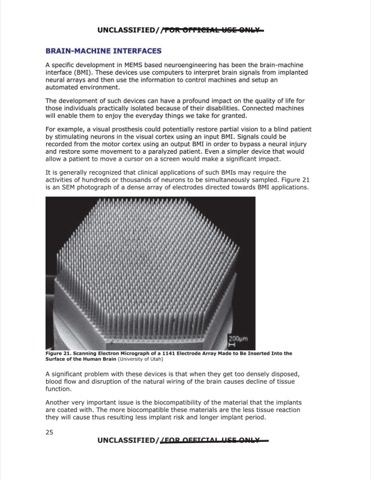
Image from page 31 of DOW-UAP-D136, as released by war.gov
Image from page 31 of the PDF. Open the scan to see the whole page.

Cite this page

U.S. Department of War. "AAWSAP DIRD, Biosensors and BioMEMS: A Survey of the Present Field, March 2010" (DOW-UAP-D136). PURSUE Release 06, U.S. Department of War, September 18, 2026. https://www.war.gov/medialink/ufo/sept-18/release-06/assets/DOW-UAP-D136_AAWSAP-DIRD-Biosensors-and-BioMEMS-A-Survey-of-the-Present-Field-March-31-2010.pdf. Declassified UAP, page 31, https://declassifieduap.org/r/dow-uap-d136-aawsap-dird-biosensors-and-biomems-a-survey-of-the-present-field-march-2010/p/31. Accessed November 28, 2026.

This address shows page 31 on its own; /r/dow-uap-d136-aawsap-dird-biosensors-and-biomems-a-survey-of-the-present-field-march-2010?page=31 opens the same page in the full reader. Both stay. How to cite.