DOW-UAP-D136

AAWSAP DIRD, Biosensors and BioMEMS: A Survey of the Present Field, March 2010, page 12

One page of a U.S. government record released under PURSUE, shown on its own with its text. The record page has the whole document, its catalog details and the scan.

Page
12 of 45
Agency
Department of War
Released
Release 06, September 18, 2026

Text of page 12

UNCLASSIFIED/ /FOR OFFICIAL USE ONL Figure 4 illustrates the basic physics where the force is generated. A voltage V, is applied to the horizontal sliding shaft. There arises an electrical field (shown as the curved arrow) that tends to pull the shaft into the cavity between the two outer combs. This is the basic motive force of the device. The force generated by each comb is very small so there are constructed many similar structures that form a comb-array. All of the forces act in parallel. (1) 1144444 (2) V X (3) Figure 4. Illustration of the Basic Physical Principle of the BioMEMS Motor (Muthuswamy et al.) The device is fabricated by using Sandia's Ultraplanar Multi-level MEMS Technology (SUMMiTV) process, a 5-layer polysilicon micromachining technology. The layers are chemically sensitive to different processes and can be selectively removed by etching with different reagents. For example silicon can be removed using an etchant which preferentially removes silicon only along certain crystalline planes. Other layers can be undermined through the use of acids. The components of the micromachine are patterned on the silicon using photoresist masks. A mask is a covering which prevents parts of the silicon from being etched away. Figure 5 gives an idea of the sophistication of this MEMS fabrication technique. B The end result is that the long rod at the right of the picture in Figure 3 moves up and down with a speed of about 1-2 mm per second. The speed can be adjusted through the number of teeth designed on the reduction gears. 6301F 20KV 21mm Figure 5. Close-Up Views of the Micro-Motor Gears (Sandia National Labs) Single unit recordings were obtained from the somatosensory cortex of adult rats over a period of three days demonstrating the feasibility of this technology. This device has been implanted in rats and its development supported by the neuroprostheses program of the US National Institutes of Health. Fluidic BioMEMS The application of microscale fabrication techniques has allowed the manipulation of very small volumes of fluids on the nanoliter and even picoliter scales. This allows 6 UNCLASSIFIED/ LEOR OFFICIAL LISE OALY

Machine-read (OCR) from the scan by this archive; it can contain errors. The scan is the record.
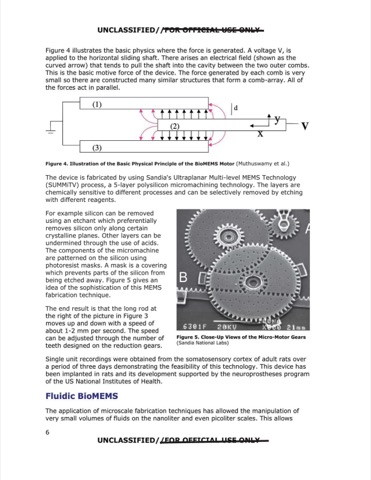
Image from page 12 of DOW-UAP-D136, as released by war.gov
Image from page 12 of the PDF. Open the scan to see the whole page.

Cite this page

U.S. Department of War. "AAWSAP DIRD, Biosensors and BioMEMS: A Survey of the Present Field, March 2010" (DOW-UAP-D136). PURSUE Release 06, U.S. Department of War, September 18, 2026. https://www.war.gov/medialink/ufo/sept-18/release-06/assets/DOW-UAP-D136_AAWSAP-DIRD-Biosensors-and-BioMEMS-A-Survey-of-the-Present-Field-March-31-2010.pdf. Declassified UAP, page 12, https://declassifieduap.org/r/dow-uap-d136-aawsap-dird-biosensors-and-biomems-a-survey-of-the-present-field-march-2010/p/12. Accessed November 28, 2026.

This address shows page 12 on its own; /r/dow-uap-d136-aawsap-dird-biosensors-and-biomems-a-survey-of-the-present-field-march-2010?page=12 opens the same page in the full reader. Both stay. How to cite.