Text of page 36
UNCLASSIFIED/ FOR OFFICIAL USE ONLY
gravitational squeezing of the vacuum in the laboratory for the purpose of inducing an
antigravity effect for propulsion applications.
QUANTUM VACUUM FIELD STRESS: NEGATIVE ENERGY FROM THE
CASIMIR EFFECT
The Casimir effect is by far the easiest
and most well known way to generate
negative energy in the lab. The Casimir
effect that is familiar to most people is
the force that is associated with the
electromagnetic quantum vacuum
(Reference 85). This is an attractive
force that must exist between any two
neutral (uncharged), parallel, flat,
conducting surfaces (for example,
metallic plates) in a vacuum. This force
has been well measured and it can be
attributed to a minute imbalance in the
vacuum electromagnetic zero-point
energy density inside the cavity between
the conducting surfaces versus the
vacuum electromagnetic zero-point
energy density in the free-space region
outside of the cavity (Reference 86-88).
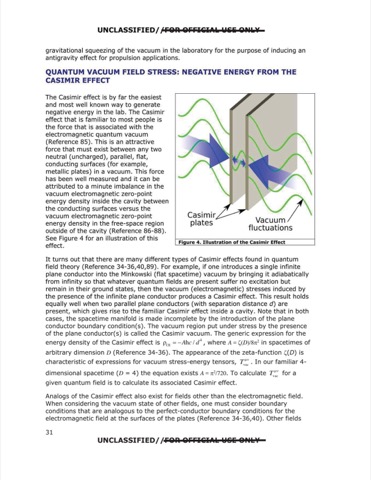
See Figure 4 for an illustration of this
effect.
Casimir
plates
Vacuum
fluctuations
Figure 4. Illustration of the Casimir Effect
It turns out that there are many different types of Casimir effects found in quantum
field theory (Reference 34-36,40,89). For example, if one introduces a single infinite
plane conductor into the Minkowski (flat spacetime) vacuum by bringing it adiabatically
from infinity so that whatever quantum fields are present suffer no excitation but
remain in their ground states, then the vacuum (electromagnetic) stresses induced by
the presence of the infinite plane conductor produces a Casimir effect. This result holds
equally well when two parallel plane conductors (with separation distance d) are
present, which gives rise to the familiar Casimir effect inside a cavity. Note that in both
cases, the spacetime manifold is made incomplete by the introduction of the plane
conductor boundary condition(s). The vacuum region put under stress by the presence
of the plane conductors) is called the Casimir vacuum. The generic expression for the
energy density of the Casimir effect is Pc =-Ahc / d*
, where A = 5(D)/82 in spacetimes of
arbitrary dimension D (Reference 34-36). The appearance of the zeta-function 5(D) is
characteristic of expressions for vacuum stress-energy tensors, Tur
vac. In our familiar 4-
dimensional spacetime (D = 4) the equation exists A = 2/720. To calculate THY for a
given quantum field is to calculate its associated Casimir effect.
Analogs of the Casimir effect also exist for fields other than the electromagnetic field.
When considering the vacuum state of other fields, one must consider boundary
conditions that are analogous to the perfect-conductor boundary conditions for the
electromagnetic field at the surfaces of the plates (Reference 34-36,40). Other fields
31
UNCLASSIFIED//FOR OFFICIAL USE ONLY