Text of page 28
UNCLASSIFIED/ FOR OFFICIAL USE ONLY
FvaWGrav
=-U(0)
vdW
Ploo
= -
478, 16
= 2.44×10-57) 9e
(29)
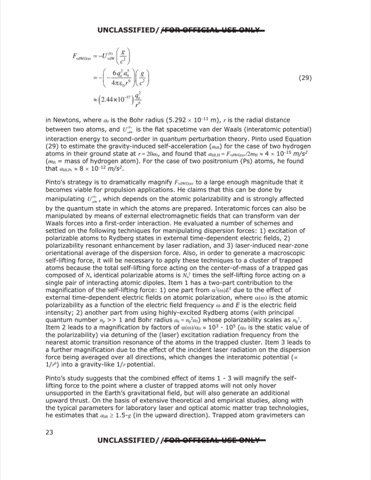
in Newtons, where ao is the Bohr radius (5.292 × 10⁻¹¹ m), r is the radial distance
between two atoms, and U, is the flat spacetime van der Waals (interatomic potential)
interaction energy to second-order in quantum perturbation theory. Pinto used Equation
(29) to estimate the gravity-induced self-acceleration (ain) for the case of two hydrogen
atoms in their ground state at r= 20ao, and found that if. = vaGrav/2m ≥ 4 × 10-15 m/s₴
(m = mass of hydrogen atom). For the case of two positronium (Ps) atoms, he found
that alifi.Ps ~ 8 × 10-12 m/s?.
Pinto's strategy is to dramatically magnify FvawGray to a large enough magnitude that it
becomes viable for propulsion applications. He claims that this can be done by
manipulating U'°)
wav, which depends on the atomic polarizability and is strongly affected
by the quantum state in which the atoms are prepared. Interatomic forces can also be
manipulated by means of external electromagnetic fields that can transform van der
Waals forces into a first-order interaction. He evaluated a number of schemes and
settled on the following techniques for manipulating dispersion forces: 1) excitation of
polarizable atoms to Rydberg states in external time-dependent electric fields, 2)
polarizability resonant enhancement by laser radiation, and 3) laser-induced near-zone
orientational average of the dispersion force. Also, in order to generate a macroscopic
self-lifting force, it will be necessary to apply these techniques to a cluster of trapped
atoms because the total self-lifting force acting on the center-of-mass of a trapped gas
composed of Na identical polarizable atoms is Na? times the self-lifting force acting on a
single pair of interacting atomic dipoles. Item 1 has a two-part contribution to the
magnification of the self-lifting force: 1) one part from a?(o)E? due to the effect of
external time-dependent electric fields on atomic polarization, where a(co) is the atomic
polarizability as a function of the electric field frequency o and E is the electric field
intensity; 2) another part from using highly-excited Rydberg atoms (with principal
quantum number np >> 1 and Bohr radius an = np ao) whose polarizability scales as np.
Item 2 leads to a magnification by factors of a(c)/do ~ 103 - 105 (ao is the static value of
the polarizability) via detuning of the (laser) excitation radiation frequency from the
nearest atomic transition resonance of the atoms in the trapped cluster. Item 3 leads to
a further magnification due to the effect of the incident laser radiation on the dispersion
force being averaged over all directions, which changes the interatomic potential (o
1/r°) into a gravity-like 1/r potential.
Pinto's study suggests that the combined effect of items 1 - 3 will magnify the self-
lifting force to the point where a cluster of trapped atoms will not only hover
unsupported in the Earth's gravitational field, but will also generate an additional
upward thrust. On the basis of extensive theoretical and empirical studies, along with
the typical parameters for laboratory laser and optical atomic matter trap technologies,
he estimates that aift ≥ 1.5-g (in the upward direction). Trapped atom gravimeters can
23
UNCLASSIFIED//FOR OFFICIAL USE ONLY