Text of page 23
UNCLASSIFIED/ FOR OFFICIAL USE ONLY
quantization procedure and order of approximation used in a given quantum gravity
theory. However, the linearized semi-classical quantum gravity theory is related to
Einstein's classical nonlinear General Relativity Theory whereby the former uniquely
implies the latter provided that the graviton, which exchanges the gravitational force
between two massive particles or photons, is a pure spin-2 particle. In this theory, the
stress-energy tensor of the source matter fields is quantized while gravitation (via the
Einstein curvature tensor) is still treated classically. Semi-classical quantum gravity is a
quantum field theory in curved spacetime that has been successful in reproducing a few
of the predictions and many of the foundational precepts of General Relativity Theory.
A particular example of what a quantum antigravity correction term looks like was
derived in 1984 by R. L. Forward and the author, with instruction provided by R. P.
Feynman and M. Scadron, during a summer quantum gravity seminar sponsored by the
Hughes Research Labs in Malibu, CA. One began by studying the Feynman quantization
procedure for the case of single-photon exchange between two charged particles, which
tells us about the underlying nature and quantum corrections to the static Coulomb
force. From this study discovered that the same is also true for the case of single-
graviton exchange between two massive spin-0 particles in connection with the static
Tear on meto at a statie
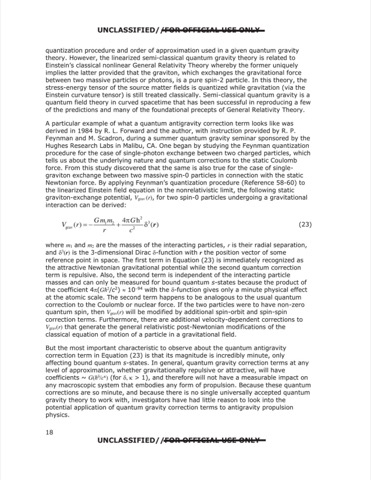
Newtonian force. By applying Feynman's quantization procedure (Reference 58-60) to
the linearized Einstein field equation in the nonrelativistic limit, the following static
graviton-exchange potential, grav (r), for two spin-0 particles undergoing a gravitational
interaction can be derived:
Gm,m,
V
grav (P) =
47Gh?
8 (r)
(23)
where mi and me are the masses of the interacting particles, r is their radial separation,
and 83(r) is the 3-dimensional Dirac 8-function with r the position vector of some
reference point in space. The first term in Equation (23) is immediately recognized as
the attractive Newtonian gravitational potential while the second quantum correction
term is repulsive. Also, the second term is independent of the interacting particle
masses and can only be measured for bound quantum s-states because the product of
the coefficient 4(Gh/c2) = 10-94 with the s-function gives only a minute physical effect
at the atomic scale. The second term happens to be analogous to the usual quantum
correction to the Coulomb or nuclear force. If the two particles were to have non-zero
quantum spin, then grav(r) will be modified by additional spin-orbit and spin-spin
correction terms. Furthermore, there are additional velocity-dependent corrections to
grav(r) that generate the general relativistic post-Newtonian modifications of the
classical equation of motion of a particle in a gravitational field.
But the most important characteristic to observe about the quantum antigravity
correction term in Equation (23) is that its magnitude is incredibly minute, only
affecting bound quantum s-states. In general, quantum gravity correction terms at any
level of approximation, whether gravitationally repulsive or attractive, will have
coefficients ~ G(h°/*) (for 8, k > 1), and therefore will not have a measurable impact on
any macroscopic system that embodies any form of propulsion. Because these quantum
corrections are so minute, and because there is no single universally accepted quantum
gravity theory to work with, investigators have had little reason to look into the
potential application of quantum gravity correction terms to antigravity propulsion
physics.
18
UNCLASSIFIED//FOR OFFICIAL USE ONLY