Text of page 16
UNCLASSIFIED/ FOR OFFICIAL USE ONLY
vehicle. This particular case study will serve as a useful illustrative comparison with the
Newtonian antigravity case discussed in Section II-A.
Interest is only in the slow (non-relativistic) motion, weak (gravity) field regime that
characterizes the physics of the Earth, Sun, other forms of solar system matter, most
interstellar matter (excluding compact dense stars and black holes), and small test
masses. In this case the time-time component of the Ricci curvature tensor (Ruv) is
given by Roo ~ Gp/C2 = (7.41 × 10⁻²⁸)p m2. This is the primary quantity inside the
general relativistic field equation that encodes and measures the curvature of
spacetime around a source of matter and characterizes the weak or strong gravity field
regime for all forms of astronomical mass density (p). For example, the Earth's mass
density is 5,500 kg/m3 so Roo ≥ 4.08 × 10⁻²⁴ m-2, which indicates that an extremely flat
space surrounds the Earth and thus the system is within the weak field regime.
Gravitational physics in the weak field regime is completely described by the standard
Schwarzschild spacetime metric, which leads to the usual Newtonian and post-
Newtonian gravitational physics.
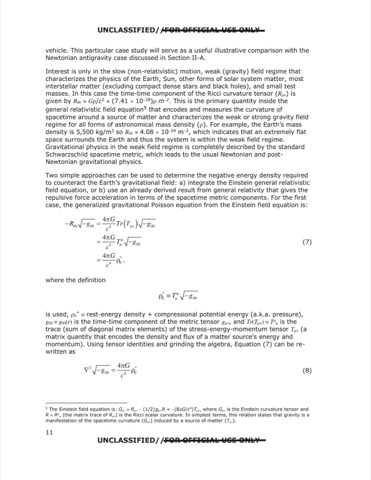
Two simple approaches can be used to determine the negative energy density required
to counteract the Earth's gravitational field: a) integrate the Einstein general relativistic
field equation, or b) use an already derived result from general relativity that gives the
repulsive force acceleration in terms of the spacetime metric components. For the first
case, the generalized gravitational Poisson equation from the Einstein field equation is:
- Roo V-800
- Tr Tuv) V-800
4m G
= -
c*
- In V-800
4M G
=
PE .
(7)
where the definition
PE = TH V
- 8 00
is used, pE* = rest-energy density + compressional potential energy (a.k.a. pressure),
800 = 800(r) is the time-time component of the metric tensor guv, and TrTuv) = Tu is the
trace (sum of diagonal matrix elements) of the stress-energy-momentum tensor Tuv (a
matrix quantity that encodes the density and flux of a matter source's energy and
momentum). Using tensor identities and grinding the algebra, Equation (7) can be re-
written as
V2 V-800
4G
=
.4 РЕ
(8)
3 The the materia trace on in the Rice scar atre Sim he ten, his relation states ture gravity is d
manifestation of the spacetime curvature (Giv) induced by a source of matter (Tv).
11
UNCLASSIFIED//FOR OFFICIAL USE ONLY