DOW-UAP-D134

AAWSAP DIRD, Maverick Inventor Versus Corporate Inventor: Where Will the Next Major Innovations Arise, March 2010, page 16

One page of a U.S. government record released under PURSUE, shown on its own with its text. The record page has the whole document, its catalog details and the scan.

Page
16 of 19
Agency
Department of War
Released
Release 06, September 18, 2026

Text of page 16

UNCLASSIFIED/ FOR eFFErAL USE ONLY These innovators have a high degree of motivation for near-term commercial projects but less motivation for exotic long-term projects and typically have specific educational qualifications in the relevant fields. They generally work on improvements to the technological status quo (Reference 31). These improvements are expected to be commercial products in the near-to-medium term, compared with the energy and propulsion technology discussed here, which have a long time horizon. What can be learned from the Type 5 inventor? He is significantly less interested than the lone maverick inventor in pursuing exotic inventions. As part of a commercial enterprise, a Type 5 inventor's motivation to investigate long-term possibilities with a low likelihood of success is small. This is not to say that the individual inventor within the group might not be the most suitable candidate for considering exotic inventions if he can operate with considerable freedom and enjoy the support and intellectual milieu of the small group. Comparisons Table 2 below compares the essential elements that characterize the types of inventors discussed in the previous sections. The various attributes shown can be used as criteria for determining the inventor type most likely to produce the necessary innovations in the areas of advanced primary energy and exotic propulsion. Table 2. Essential Elements That Characterize the Types of Inventor Attribute Type 1 (& 2) Age Younger Motivation High Realism Low Bureaucracy Low Low (& Capitalization Medium) Education Low Business Low Sense Measurement Low Lab Skills Low Externals Low Flexibility High Media Interest | High Type 3 and 4 Older High Medium Low Low (& Medium) High Various Medium High High High Low Type 5 Younger Medium High Medium Medium Mixed High Medium - High High Medium Medium Mixed Corporate Various Various High High High High Medium High High High Medium Low For clarity and compactness, Types 1 and 2 and Types 3 and 4 are combined, since in general the only meaningful difference is the capitalization. As discussed above, unfortunately, merely having more funding does not lead to substantially greater capabilities in other areas. Motivation: degree of commitment to initiating and completing the task and belief that it is possible a priori. Realism: degree of realization of the difficulties to be faced. 11 UNCLASSIFIED/ LEOR OFFICIAL USE ONLY

Machine-read (OCR) from the scan by this archive; it can contain errors. The scan is the record.
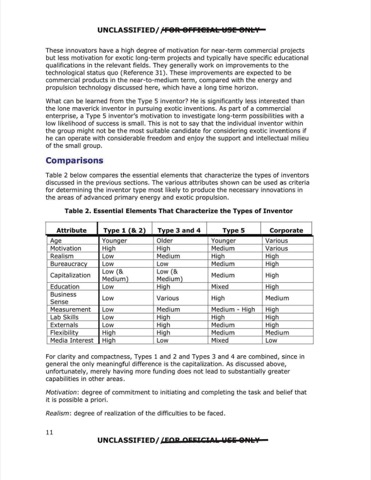
Image from page 16 of DOW-UAP-D134, as released by war.gov
Image from page 16 of the PDF. Open the scan to see the whole page.

Cite this page

U.S. Department of War. "AAWSAP DIRD, Maverick Inventor Versus Corporate Inventor: Where Will the Next Major Innovations Arise, March 2010" (DOW-UAP-D134). PURSUE Release 06, U.S. Department of War, September 18, 2026. https://www.war.gov/medialink/ufo/sept-18/release-06/assets/DOW-UAP-D134_AAWSAP-DIRD-Maverick-Inventor-Versus-Corporate-Inventor-Where-Will-the-Next-Major-Innovations-Arise-March-30-2010.pdf. Declassified UAP, page 16, https://declassifieduap.org/r/dow-uap-d134-aawsap-dird-maverick-inventor-versus-corporate-inventor-where-will-the-next-major-innovations-arise-march-2010/p/16. Accessed November 28, 2026.

This address shows page 16 on its own; /r/dow-uap-d134-aawsap-dird-maverick-inventor-versus-corporate-inventor-where-will-the-next-major-innovations-arise-march-2010?page=16 opens the same page in the full reader. Both stay. How to cite.