DOW-UAP-D133

AAWSAP DIRD, The Space Communication Implications of Quantum Entanglement and Nonlocality, March 2010, page 8

One page of a U.S. government record released under PURSUE, shown on its own with its text. The record page has the whole document, its catalog details and the scan.

Page
8 of 32
Agency
Department of War
Released
Release 06, September 18, 2026

Text of page 8

UNCLASSIFIED// FOR OFFICIAL USE ONLY implications of this dichotomy are considered in the context of the "no-signal" theorems. It is noted that there is some misinformation in the literature concerning the chronology of successful EPR polarization correlation experiments, and here we wish to set the record at least somewhat straighter. The experimental measurement that first demonstrated a polarization correlation related to EPR nonlocality was performed by C. S. Wu and I. Shanknov in 1949 (Reference 7), well before Bell's work and the subsequent interest in testing Bell's Inequality. Wu and Shanknov showed that the linear polarizations of back-to-back entangled gamma rays from electron-positron annihilation (an L=0 negative parity state) were anticorrelated, for example, if one photon was polarized vertically, then the other was polarized horizontally. They did not, however, investigate the falloff of the correlation with polarimeter angle, which is the basis of Bell Inequality tests, nor did they depict their results as a consequence of quantum nonlocality. Almost two decades passed before the publication of John Bell's pivotal work (Reference 8) in 1964 and 1966. In 1972, Freedman and Clauser (Reference 1) performed the first definitive Bell inequality test by measuring the polarization correlation of entangled photons from a positive parity L=0 atomic cascade in calcium. Their results were in agreement with the predictions of quantum mechanics and were inconsistent with local hidden-variable theories by 6.7 standard deviations. A decade later, in 1982, EPR measurements of the Aspect group (Reference 2) eliminated several "loophole" scenarios that might constitute unlikely ways of preserving classical locality and again demonstrated agreement with quantum mechanics and inconsistency with local hidden- variable theories, this time by 46 standard deviations. In a more recent example of an EPR experiment, the Gisin group (Reference 9) used the fiber-optic cables owned by the Swiss Telephone System to demonstrate the nonlocal connection between EPR measurements made at locations in Geneva and Bern, Swiss cities with a line-of-sight separation of 156 km—a direct demonstration, if one was required, that quantum nonlocality can operate over quite large distances. Ca-OVEN LENS LENS FILTER 2 FILTER 1 PM2 POLARIZER 2 POLARIZER I PMO LENS ENS FILTER D LENS DISC. DISC. - AMP! -DELAY P.H. A. COINC - COINC. TA.C. Figure 1. Schematic of the 1972 Freedman-Clauser Experiment (Reference 1) 2 UNCLASSIFIED//FOR OFFICIAL USE ONLY

Machine-read (OCR) from the scan by this archive; it can contain errors. The scan is the record.
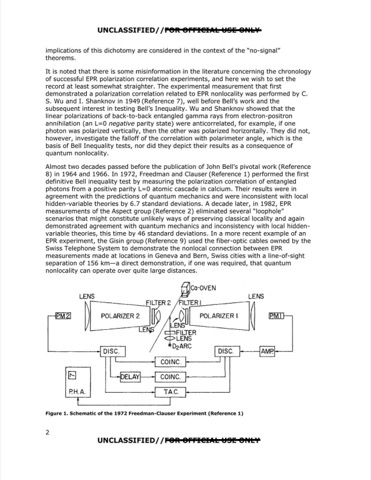
Image from page 8 of DOW-UAP-D133, as released by war.gov
Image from page 8 of the PDF. Open the scan to see the whole page.

Cite this page

U.S. Department of War. "AAWSAP DIRD, The Space Communication Implications of Quantum Entanglement and Nonlocality, March 2010" (DOW-UAP-D133). PURSUE Release 06, U.S. Department of War, September 18, 2026. https://www.war.gov/medialink/ufo/sept-18/release-06/assets/DOW-UAP-D133_AAWSAP-DIRD-The-Space-Communication-Implications-of-Quantum-Entanglement-and-Nonlocality-March-30-2010.pdf. Declassified UAP, page 8, https://declassifieduap.org/r/dow-uap-d133-aawsap-dird-the-space-communication-implications-of-quantum-entanglement-and-nonlocality-march-2010/p/8. Accessed November 28, 2026.

This address shows page 8 on its own; /r/dow-uap-d133-aawsap-dird-the-space-communication-implications-of-quantum-entanglement-and-nonlocality-march-2010?page=8 opens the same page in the full reader. Both stay. How to cite.