DOW-UAP-D133

AAWSAP DIRD, The Space Communication Implications of Quantum Entanglement and Nonlocality, March 2010, page 6

One page of a U.S. government record released under PURSUE, shown on its own with its text. The record page has the whole document, its catalog details and the scan.

Page
6 of 32
Agency
Department of War
Released
Release 06, September 18, 2026

Text of page 6

UNCLASSIFIED//FOR OFFICIAL USE ONLY paper attempts to address these questions by taking a close look at quantum entanglement, quantum nonlocality, the experiments that have explored them, and proposed experiments to test the causal and faster-than-light communication issues evoked by such physics. Quantum entanglement describes the condition of separated parts of the same quantum system in which each of the parts can be described only by referencing the state of other parts. This is one of the most counterintuitive aspects of quantum mechanics, because classically one would expect system parts out of "local" contact to be completely independent. Thus, entanglement represents a kind of quantum "connectedness" in which measurements on one isolated part of an entangled quantum system have nonclassical consequences for the outcome of measurements performed on the other (possibly very distant) part of the same system. This quantum connectedness acting in entangled quantum systems is called quantum nonlocality. Nonlocality was first highlighted by Albert Einstein and his coworkers Boris Podolsky and Nathan Rosen in their famous EPR paper (Reference 4). They argued that the nonlocal connectedness of quantum systems was unphysical in that it implied a faster-than-light connection in apparent conflict with special relativity. Despite their objection, quantum nonlocality has now been demonstrated (see Section I) in many quantum systems (Reference 1, 2). In the physics community, it is now generally acknowledged to be implicit in the quantum formalism as applied to entangled systems, although there remain a few Copenhagen "holdouts" who would require an explicit demonstration of nonlocal signaling before admitting that nonlocality can be considered a real quantum phenomenon. The question investigated in this paper is whether quantum nonlocality is the private domain of nature or whether it can be used in experimental situations to send signals from one observer to another. As we will see, there is at present no compelling answer to this question. However, it is clear that if such nonlocal observer-to-observer communication were possible, it would have far-reaching implications. In particular, it would represent an enabling technology for superluminal (and retrocausal) signaling and communications, and perhaps make possible the real-time exploration of the universe. V UNCLASSIFIED// FOR OFFICIAL USE ONLY

Machine-read (OCR) from the scan by this archive; it can contain errors. The scan is the record.
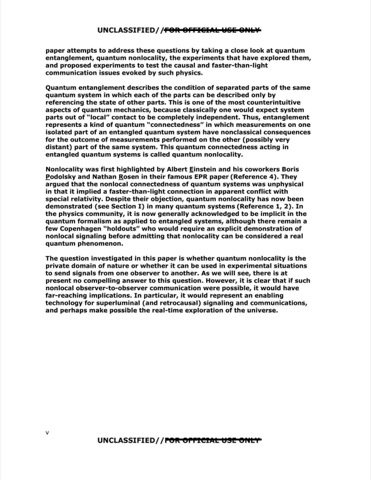
Image from page 6 of DOW-UAP-D133, as released by war.gov
Image from page 6 of the PDF. Open the scan to see the whole page.

Cite this page

U.S. Department of War. "AAWSAP DIRD, The Space Communication Implications of Quantum Entanglement and Nonlocality, March 2010" (DOW-UAP-D133). PURSUE Release 06, U.S. Department of War, September 18, 2026. https://www.war.gov/medialink/ufo/sept-18/release-06/assets/DOW-UAP-D133_AAWSAP-DIRD-The-Space-Communication-Implications-of-Quantum-Entanglement-and-Nonlocality-March-30-2010.pdf. Declassified UAP, page 6, https://declassifieduap.org/r/dow-uap-d133-aawsap-dird-the-space-communication-implications-of-quantum-entanglement-and-nonlocality-march-2010/p/6. Accessed November 28, 2026.

This address shows page 6 on its own; /r/dow-uap-d133-aawsap-dird-the-space-communication-implications-of-quantum-entanglement-and-nonlocality-march-2010?page=6 opens the same page in the full reader. Both stay. How to cite.