DOW-UAP-D133

AAWSAP DIRD, The Space Communication Implications of Quantum Entanglement and Nonlocality, March 2010, page 23

One page of a U.S. government record released under PURSUE, shown on its own with its text. The record page has the whole document, its catalog details and the scan.

Page
23 of 32
Agency
Department of War
Released
Release 06, September 18, 2026

Text of page 23

UNCLASSIFIED//FOR OFFICIAL USE ONLY VIII. Superluminal and Retrocausal Nonlocal Communication As mentioned in the previous section, we will assume for the sake of discussion that nonlocal signaling is possible and will consider its implications for the speed of transmission of signals. For definiteness, schemes for doing this are based on the slit- imaging coincidence-free version of the Ghost Interference experiment described above and shown in Figure 7. In that system, the instant at which a nonlocal signal is sent is the arrival of the VLP photon at the fiber-optic system on the left, and the instant at which the signal is received is the arrival of the HLP photon at the camera at the bottom of the diagram. Assuming the workability of this scheme, both the instants of sending and of receiving can be delayed, in principle, by the introduction of delay paths-for example, runs of fiber-optic cables-in the system. In particular, the "send" instant could be made to occur well after the "receive" instant in the system, constituting a direct demonstration of retrocausal signaling. This is shown in Figure 10. Here the cleanup two-slit system S becomes the entrance for two 10-km-long runs of fiber-optics that are carefully matched to have identical exit phases at Ss, the end of the fiber runs where the light enters the optical switching arrangement described above. If the index of refraction of the fiber is 1.5, light transiting the 10-km path requires about 50 us. In the presence of detection noise or the degradation of pattern visibility because of compromises between entanglement and coherence, considerably more photon detection events-say 100-might be required. BBO 10 km S, D + D+ O D- iS witch Destination Apertures IR Pass Filter Image Slits Path to Lens = f 10 km Double Convex Lens Focal Length = f - VLP 702 nm IR Pass Filter - Polarizing 7 Splitter 4 IR Pass Filter HLP 702 nm Object Slits Path to Lens =/||S, Camera "O" n VLP 351 nm Argon lon Laser Figure 10. Slit-Imaging Coincidence-Free Version of the Ghost Interference Experiment Demonstrating Superluminal and Retrocausal Signaling 17 UNCLASSIFIED// FOR OFFICIAL USE ONLY

Machine-read (OCR) from the scan by this archive; it can contain errors. The scan is the record.
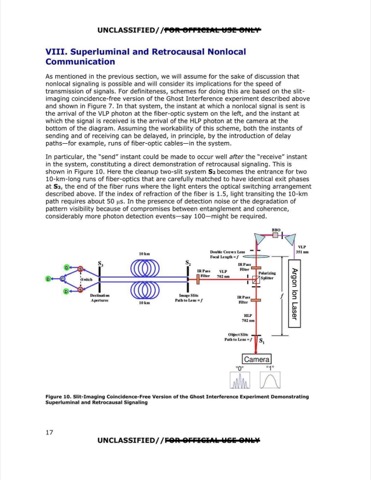
Image from page 23 of DOW-UAP-D133, as released by war.gov
Image from page 23 of the PDF. Open the scan to see the whole page.

Cite this page

U.S. Department of War. "AAWSAP DIRD, The Space Communication Implications of Quantum Entanglement and Nonlocality, March 2010" (DOW-UAP-D133). PURSUE Release 06, U.S. Department of War, September 18, 2026. https://www.war.gov/medialink/ufo/sept-18/release-06/assets/DOW-UAP-D133_AAWSAP-DIRD-The-Space-Communication-Implications-of-Quantum-Entanglement-and-Nonlocality-March-30-2010.pdf. Declassified UAP, page 23, https://declassifieduap.org/r/dow-uap-d133-aawsap-dird-the-space-communication-implications-of-quantum-entanglement-and-nonlocality-march-2010/p/23. Accessed November 28, 2026.

This address shows page 23 on its own; /r/dow-uap-d133-aawsap-dird-the-space-communication-implications-of-quantum-entanglement-and-nonlocality-march-2010?page=23 opens the same page in the full reader. Both stay. How to cite.