DOW-UAP-D133

AAWSAP DIRD, The Space Communication Implications of Quantum Entanglement and Nonlocality, March 2010, page 15

One page of a U.S. government record released under PURSUE, shown on its own with its text. The record page has the whole document, its catalog details and the scan.

Page
15 of 32
Agency
Department of War
Released
Release 06, September 18, 2026

Text of page 15

UNCLASSIFIED//FOR ® I USE ONLY Another momentum-entangled EPR experiment was the 1998 Ph.D. thesis of Birgit Dopfer (Reference 17) performed at the University of Innsbruck and shown schematically in Figure 5. In the Dopfer experiment, moving a detector in one arm nonlocally changes the observed interference pattern in the other arm. Dopfer used 351-nm UV pump radiation from an argon-ion laser with Type I down-conversion in a nonlinear LilOs crystal cut with the optic axis at 90° to the pump beam to produce a pair of 702-m momentum-entangled photons that emerged from the crystal at angles of 28.2° to the right and left of the pump axis, as shown in Figure 5. * 351.1 nm LilOs 2f 702.2 nm 702.2 nm S, Coincidence D, Figure 5. Schematic of the 1998 Dopfer Experiment (Reference 17) The lower entangled photon passed through a pair of slits and into a detector, while the upper photon passed through a lens that could image the two slits to perform a "which- way" measurement if detector Da was placed two focal lengths behind the lens (2f). However, if detector De was placed in a position one focal length behind the lens (f), the slits were not imaged, and light on the reflected line passing through either slit could reach the detector at the same points, producing a result similar to that of the Ghost Interference experiment. A structured two-slit interference pattern could be switched on and off by moving a detector in the other arm of the experiment between the f and 2f positions. Again, from the viewpoint of nonlocal communication, it is noted that moving detector Da, which can be thought of as the action of a "sending" observer, nonlocally causes an observable change in the position distribution of the second photon, as detected at "receiver" position Di. However, the Dopfer experiment does not demonstrate nonlocal communication because, like the Ghost Interference experiment, it requires a classical communication link to impose the coincidence requirement between the detected photons because of the geometry of the experiment. Examination of these two experiments raises a very interesting question: Can the coincidence requirement be removed? The answer is not clear. In principle, the two entangled photons are connected by nonlocality whether they are detected in coincidence or not. The coincidence should therefore be removable. However, in both experiments the authors report that no two-slit interference distribution is observed 9 UNCLASSIFIED//FOR OFFICIAL USE ONLY

Machine-read (OCR) from the scan by this archive; it can contain errors. The scan is the record.
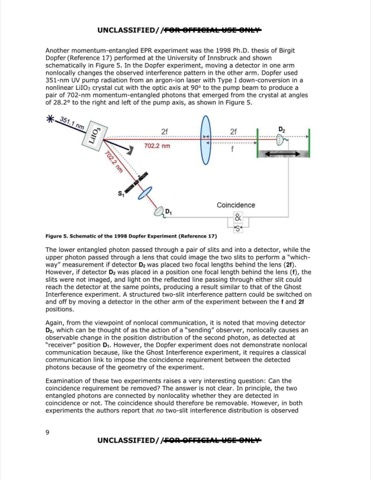
Image from page 15 of DOW-UAP-D133, as released by war.gov
Image from page 15 of the PDF. Open the scan to see the whole page.

Cite this page

U.S. Department of War. "AAWSAP DIRD, The Space Communication Implications of Quantum Entanglement and Nonlocality, March 2010" (DOW-UAP-D133). PURSUE Release 06, U.S. Department of War, September 18, 2026. https://www.war.gov/medialink/ufo/sept-18/release-06/assets/DOW-UAP-D133_AAWSAP-DIRD-The-Space-Communication-Implications-of-Quantum-Entanglement-and-Nonlocality-March-30-2010.pdf. Declassified UAP, page 15, https://declassifieduap.org/r/dow-uap-d133-aawsap-dird-the-space-communication-implications-of-quantum-entanglement-and-nonlocality-march-2010/p/15. Accessed November 28, 2026.

This address shows page 15 on its own; /r/dow-uap-d133-aawsap-dird-the-space-communication-implications-of-quantum-entanglement-and-nonlocality-march-2010?page=15 opens the same page in the full reader. Both stay. How to cite.