DOW-UAP-D133

AAWSAP DIRD, The Space Communication Implications of Quantum Entanglement and Nonlocality, March 2010, page 13

One page of a U.S. government record released under PURSUE, shown on its own with its text. The record page has the whole document, its catalog details and the scan.

Page
13 of 32
Agency
Department of War
Released
Release 06, September 18, 2026

Text of page 13

UNCLASSIFIED//FOR I USE ONLY The experimenters demonstrated that passing the vertically polarized photon (e) through a double- or single-slit system before detection at Di produced a "comb" interference distribution or a "bump" diffraction distribution, respectively, in the position X2 of the horizontally polarized photon (o) detected at De when the pair of photons is examined in coincidence. In other words, the position distribution of the straight-through photon shows patterns characteristic of the single or double- slit system through which its twin entangled photon passed. Figure 3 shows the observed position distributions for the two cases. 300 (a) Two slits 250 Coincidence counts 200 150 100 50 -2 Detector 2 position (mm) 500 (b) One slit Coincidence counts 400 300 From the viewpoint of nonlocal 200 communication, we note that modifying the slit system before D, through which 100 the reflected photon passes, which can be thought of as the action of a "sending" observer, nonlocally causes an observable change in the X2-position distribution of the undeflected photon, Figure 3. Ghost Interference Position Distributions as detected by a "receiving" observer at D2. This is a nonclassical effect that demonstrates the nonlocal connection between the entangled pair and that might form the basis for transmission of a nonlocal signal between the two observers. However, the Ghost Interference experiment does not, in the form reported, demonstrate nonlocal communication, because of its use of a classical communication link in imposing the coincidence requirement between the detected photons. In their paper, the authors comment that with the two-slit system in place, in the absence of coincidences there is no observable two-slit interference pattern distributions at either Di or D2. They attribute this lack of an interference "signal" to the horizontal variation in the creation position of the down-converted photons. The variation is enough to cause the "e" photons to arrive at the two slits with relative path lengths that may differ by more than a wavelength, thereby randomly shifting and was very infic in aerenis. Only about indor, pheir photons prougled photons entangled pair, while many unentangled "noise" photons of the same wavelength were created by fluorescence in the crystal. Therefore, even if the coincidence requirement had been in principle removable (see below), it is not surprising that coincidences were required to observe the reported effects. 7 UNCLASSIFIED//FOR OFFICIAL USE ONLY

Machine-read (OCR) from the scan by this archive; it can contain errors. The scan is the record.
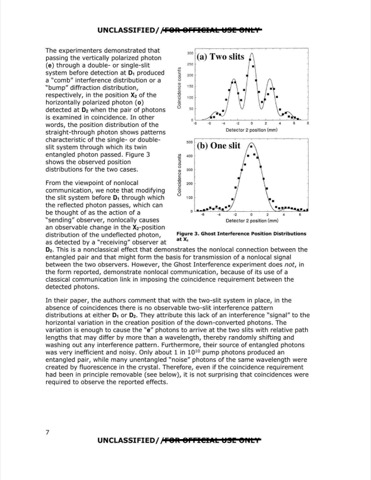
Image from page 13 of DOW-UAP-D133, as released by war.gov
Image from page 13 of the PDF. Open the scan to see the whole page.

Cite this page

U.S. Department of War. "AAWSAP DIRD, The Space Communication Implications of Quantum Entanglement and Nonlocality, March 2010" (DOW-UAP-D133). PURSUE Release 06, U.S. Department of War, September 18, 2026. https://www.war.gov/medialink/ufo/sept-18/release-06/assets/DOW-UAP-D133_AAWSAP-DIRD-The-Space-Communication-Implications-of-Quantum-Entanglement-and-Nonlocality-March-30-2010.pdf. Declassified UAP, page 13, https://declassifieduap.org/r/dow-uap-d133-aawsap-dird-the-space-communication-implications-of-quantum-entanglement-and-nonlocality-march-2010/p/13. Accessed November 28, 2026.

This address shows page 13 on its own; /r/dow-uap-d133-aawsap-dird-the-space-communication-implications-of-quantum-entanglement-and-nonlocality-march-2010?page=13 opens the same page in the full reader. Both stay. How to cite.