DOW-UAP-D132

AAWSAP DIRD, Advanced Space Propulsion Based on Vacuum (Spacetime Metric) Engineering, March 2010, page 16

One page of a U.S. government record released under PURSUE, shown on its own with its text. The record page has the whole document, its catalog details and the scan.

Page
16 of 17
Agency
Department of War
Released
Release 06, September 18, 2026

Text of page 16

UNCLASSIFIED//FOR Warp Field LT Flat Spacetime 144р Gravity Field Figure 3. Alcubierre Warp Drive Metric Structure IV. Discussion This paper has considered the possibility-even likelihood —that future developments with regard to advanced aerospace technologies will trend in the direction of manipulating the underlying spacetime structure of the vacuum of space itself by processes that can be called vacuum engineering or metric engineering. Far from being simply a fanciful concept, a significant literature exists in peer-reviewed, Tier 1 physics publications in which the topic is explored in detail. 3 The analysis presented herein, a form of general relativity for engineers, takes advantage of the fact that in GR a minimal-assumption, metric tensor approach can be used that is model-independent-that is, it does not depend on knowledge of the specific mechanisms or dynamics that result in spacetime alterations but rather only assumes that a technology exists that can control and manipulate (that is, engineer) the spacetime variables to advantage. Such an approach requires only that the hypothesized spacetime alterations result in effects consonant with the currently known GR physics principles. In the metric engineering approach, the application of the principles gives precise predictions as to what can be expected as spatial and temporal variables are altered from their usual (that is, flat space) structure. Signatures of the predicted contractions and expansions of space, slowdown and speedup of time, alteration of effective mass, speed of light and associated consequences, both as occur in natural phenomena in nature and with regard to spacetimes specifically engineered for advanced aerospace applications, are succinctly summarized in Table 1. Of particular interest with regard to innovative forms of advanced aerospace craft are the features tabulated in the right-hand column of Table 1, features that presumably describe an ideal craft for interstellar travel: an ability to travel at superluminal speeds * See Reference 1 for a comprehensive introduction to the subject with contributions from lead scientists from around the globe. 11 UNCLASSIFIED//FOR OFFICIAL USE ONLY

Machine-read (OCR) from the scan by this archive; it can contain errors. The scan is the record.
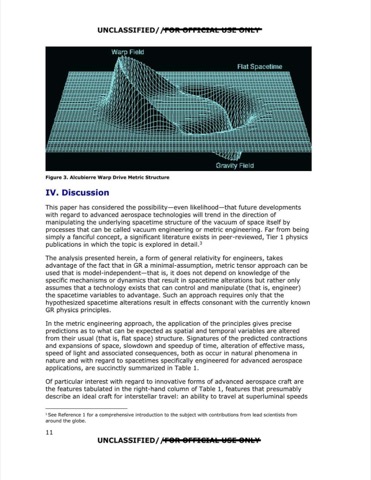
Image from page 16 of DOW-UAP-D132, as released by war.gov
Image from page 16 of the PDF. Open the scan to see the whole page.

Cite this page

U.S. Department of War. "AAWSAP DIRD, Advanced Space Propulsion Based on Vacuum (Spacetime Metric) Engineering, March 2010" (DOW-UAP-D132). PURSUE Release 06, U.S. Department of War, September 18, 2026. https://www.war.gov/medialink/ufo/sept-18/release-06/assets/DOW-UAP-D132_AAWSAP-DIRD-Advanced-Space-Propulsion-Based-on-Vacuum-Spacetime%20Metric-Engineering-March-29-2010.pdf. Declassified UAP, page 16, https://declassifieduap.org/r/dow-uap-d132-aawsap-dird-advanced-space-propulsion-based-on-vacuum-spacetime-metric-engineering-march-2010/p/16. Accessed November 28, 2026.

This address shows page 16 on its own; /r/dow-uap-d132-aawsap-dird-advanced-space-propulsion-based-on-vacuum-spacetime-metric-engineering-march-2010?page=16 opens the same page in the full reader. Both stay. How to cite.