DOW-UAP-D132

AAWSAP DIRD, Advanced Space Propulsion Based on Vacuum (Spacetime Metric) Engineering, March 2010, page 14

One page of a U.S. government record released under PURSUE, shown on its own with its text. The record page has the whole document, its catalog details and the scan.

Page
14 of 17
Agency
Department of War
Released
Release 06, September 18, 2026

Text of page 14

UNCLASSIFIED// FOR eI USE ONLY REFRACTIVE INDEX EFFECTS When considering metric-engineered spacetime associated with exotic propulsion, a number of corollary side effects associated with refractive index changes of the vacuum structure emerge as possibilities. Expected effects would mimic known refractive index effects in general and can therefore be determined from known phenomena. Indistinct boundary definition associated with "waviness" as observed with heat waves off a desert floor is one example. As another, a light beam may bend (as in the GR example of the bending of starlight as it grazes the sun; see Figure 2) or even terminate in mid-space. Such an observation would exhibit features that under ordinary circumstances would be associated with a high- refractive index optical fiber in normal space (well-defined boundaries, light trapped within, bending or termination in mid-space). Additional observations might include apparent changes in size or shape (changes in lensing Figure 2. Light-Bending in a Spacetime-Altered magnification parameters). Yet another possibility is the sudden "cloaking" or "blinking out," which would at least be consistent with strong gravitational lensing effects that bend a background view around a craft, though other technical options involving, for example, the use of metamaterials, exist as well. EFFECTIVE MASS IN SPACETIME-ALTERED REGIONS As noted in the preceding sections, spacetime alteration of energy and light-speed measures leads to an associated alteration in the effective mass of an object in a spacetime-altered region as viewed from an external (unaltered) region. Of special interest is the case in which the effective mass is decreased by application of spacetime metric engineering principles as might be expected in the case of metric engineering for spaceflight applications (reference last column in Table 1). Effective reduction of inertial mass as viewed in our frame of reference would appear to mitigate against untoward effects on craft occupants associated with abrupt changes in movement. (The physical principles involved can also be understood in terms of associated coordinate transformation properties as discussed above.) In any case, changes in effective mass associated with engineering of the spacetime metric in a craft's environs can lead to properties advantageous for spaceflight applications. 9 UNCLASSIFIED//FOR OFFICIAL USE ONLT

Machine-read (OCR) from the scan by this archive; it can contain errors. The scan is the record.
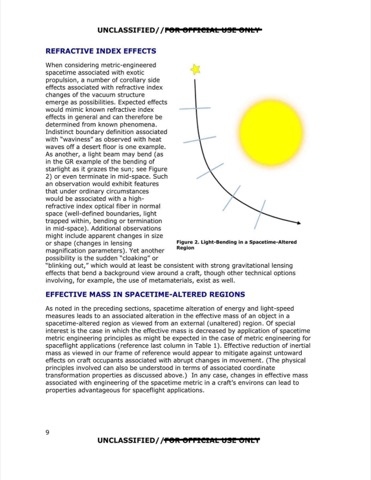
Image from page 14 of DOW-UAP-D132, as released by war.gov
Image from page 14 of the PDF. Open the scan to see the whole page.

Cite this page

U.S. Department of War. "AAWSAP DIRD, Advanced Space Propulsion Based on Vacuum (Spacetime Metric) Engineering, March 2010" (DOW-UAP-D132). PURSUE Release 06, U.S. Department of War, September 18, 2026. https://www.war.gov/medialink/ufo/sept-18/release-06/assets/DOW-UAP-D132_AAWSAP-DIRD-Advanced-Space-Propulsion-Based-on-Vacuum-Spacetime%20Metric-Engineering-March-29-2010.pdf. Declassified UAP, page 14, https://declassifieduap.org/r/dow-uap-d132-aawsap-dird-advanced-space-propulsion-based-on-vacuum-spacetime-metric-engineering-march-2010/p/14. Accessed November 28, 2026.

This address shows page 14 on its own; /r/dow-uap-d132-aawsap-dird-advanced-space-propulsion-based-on-vacuum-spacetime-metric-engineering-march-2010?page=14 opens the same page in the full reader. Both stay. How to cite.