DOW-UAP-D130

AAWSAP DIRD, Technological Approaches to Controlling External Devices, March 2010, page 24

One page of a U.S. government record released under PURSUE, shown on its own with its text. The record page has the whole document, its catalog details and the scan.

Page
24 of 36
Agency
Department of War
Released
Release 06, September 18, 2026

Text of page 24

UNCLASSIFIED//FOl NEW ELECTRODE DESIGNS Building upon studies like Parikh et al., designs look toward invasive systems capable of pinpointing cortical regions and monitoring their neural activity at or near single neuron resolution. Clement et al. employed microwire neural implants to combine fMRI and intracortical recordings to yield important information about metabolic mechanisms that correlate with neural activity. While modeling studies have been conducted in numerous experiments, they served as a baseline to understand the potential dangers associated with the strong static magnetic field alone or while exposed to typical MRI protocols on the surrounding tissue and the design of an MRI compatible electrical array (References 48, 49). On the surface this may seem a trivial task, however the study shows this is not only a challenging design detail, but decisive in the resulting recorded data of neural activity. Examples of the electrode designs are shown in Figure 8. Figure 8. The Michigan Electrodes. Left: A variety of different silicon probes have been placed on the back of a U.S. penny. The copper scaffold in the background is the array of columns on the Lincoln Memorial. Right: Four 64- site probes have been assembled into a three-dimensional structure. (Reference 49) Previous work addressed important issues related to short-term compatibility of silicon microelectrodes. In that report, identification and replacement of appropriate components of a silicon microelectrode system resulted in virtually artifact-free MR images and stable recordings of motor unit activity, although chronic studies were not performed (Reference 50). By utilizing this knowledge the authors designed a microwire electrode array capable of surviving the strong magnetic fluctuations exhibited from an MRI. Figure 9 shows the device and its related connective components (Reference 51). Figure 10 shows the before and after MR images when connectors and structural screws compatible with MR are employed as well as the compatible electrodes. 18 UNCLASSIFIED//FOR OFFICIAL USE ONLY

Machine-read (OCR) from the scan by this archive; it can contain errors. The scan is the record.
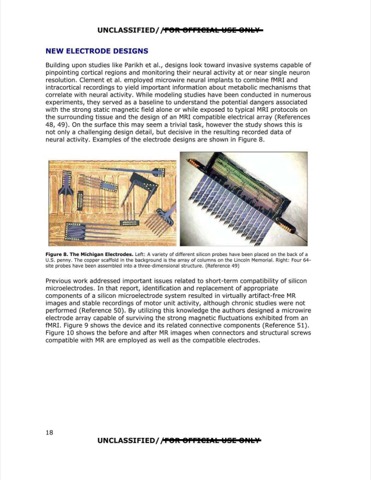
Image from page 24 of DOW-UAP-D130, as released by war.gov
Image from page 24 of the PDF. Open the scan to see the whole page.

Cite this page

U.S. Department of War. "AAWSAP DIRD, Technological Approaches to Controlling External Devices, March 2010" (DOW-UAP-D130). PURSUE Release 06, U.S. Department of War, September 18, 2026. https://www.war.gov/medialink/ufo/sept-18/release-06/assets/DOW-UAP-D130_AAWSAP-DIRD-Technological-Approaches-to-Controlling-External-Devices-March-23-2010.pdf. Declassified UAP, page 24, https://declassifieduap.org/r/dow-uap-d130-aawsap-dird-technological-approaches-to-controlling-external-devices-march-2010/p/24. Accessed November 28, 2026.

This address shows page 24 on its own; /r/dow-uap-d130-aawsap-dird-technological-approaches-to-controlling-external-devices-march-2010?page=24 opens the same page in the full reader. Both stay. How to cite.